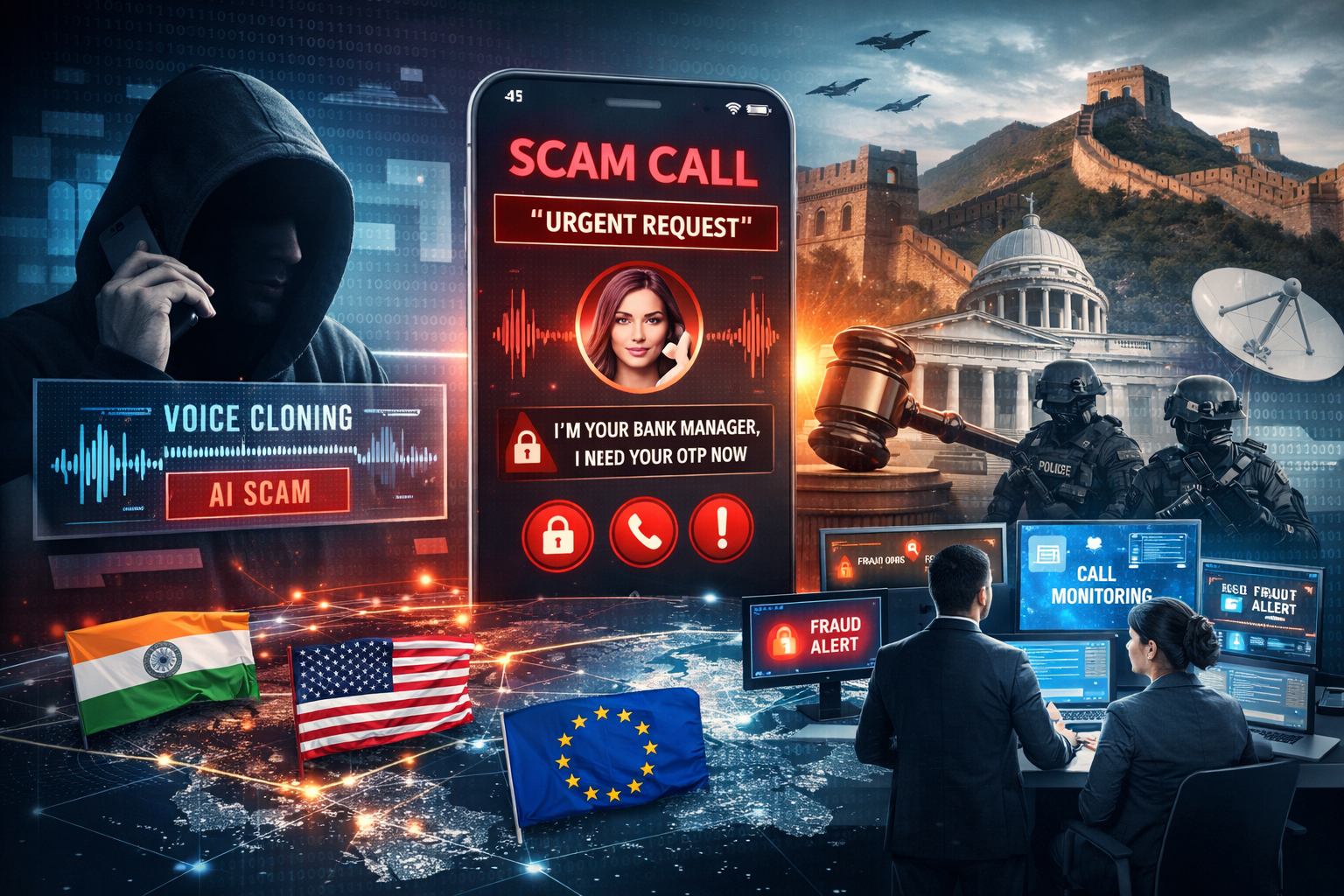
How AI Call Agents Are Changing the Scam Landscape — And What Governments & Organizations Must Do
The New Era of AI-Powered Scam Calls
Automated calling systems are not new. What is new is the arrival of cheap, high-quality generative audio and conversational AI that can speak, reason, and impersonate people with alarming fidelity. Those capabilities turn ordinary nuisance robocalls into convincing vishing — voice phishing — and create a real security problem for citizens, businesses, and states.
This post explains how AI call agents are being used in fraud and spam, the consequences for people in India, the United States, and other developed countries, and a practical playbook for organizations and governments to manage the risk.
What 'AI Call Agents' Mean in Practice
An AI call agent is an automated system that combines voice synthesis and voice cloning to imitate a real person, conversational AI to answer questions, persuade, and adapt, and telephony automation to place or route calls at scale.
Together these components let attackers run interactive scams that sound human, handle objections, and impersonate relatives, executives, bank staff, or government officials. Voice cloning models can often produce convincing audio from very small voice samples, so recorded public content or short clips are enough to build a convincing impersonation.
How Attackers Use AI Call Agents
Personalized fraud / vishing: Attackers synthesize a victim's relative's voice to pressure them to transfer money or reveal OTPs. These calls feel urgent and familiar.
CEO / executive impersonation (business email and voice compromise): AI-generated voice used in tandem with forged messages to trick employees into approving large wire transfers. Large corporate losses have already occurred using deepfake audio in board-level scams.
Automated social engineering at scale: AI agents carry dozens or thousands of concurrent conversations, handle objections, and adapt scripts to increase conversions compared with static robocalls.
Credential harvesting and account takeover: By sounding authoritative (bank staff, telco reps), AI agents coax login codes and verification data that defeat many weak authentication flows.
Real-World Impact: United States
Financial losses are large. Recent FTC and industry data show billions in consumer losses from phone scams and rising average loss per victim. Even as complaint volumes have fallen due to regulatory work, the financial impact is increasing where fraud succeeds.
Well-developed digital banking and voice-biometrics adoption create both targets and defenses. Fraudsters exploit voice-biometrics and social-engineering gaps; regulators (FCC/FTC) have updated rules to include AI-generated impersonation in their enforcement priorities.
Real-World Impact: India
Spam and unwanted calls are a daily problem for many citizens; surveys and regulator filings show extremely high exposure to spam calls. That ubiquity lowers vigilance and increases the pool of victims for sophisticated AI scams.
India has strong telecommunications controls, and TRAI is actively updating rules on unsolicited commercial communication, but enforcement and user education remain challenging at scale.
Real-World Impact: Other Developed Countries
High digital penetration means attackers can blend social engineering with data from breaches and social media to create tailored, convincing calls. The result: reputational harms, financial loss, and erosion of trust in phone and remote verification channels.
Reports show growing incidents where AI-enabled impersonation was central to large frauds across Europe, Australia, and East Asia.
Wider Societal Risks
Erosion of trust: Public trust in phone calls and teleconferencing can fall, making legitimate outreach (healthcare, emergency services, banking alerts) harder.
Targeting vulnerable populations: Elderly people and those unfamiliar with online fraud are at disproportionate risk from AI-powered voice scams.
National security & information operations: State or state-aligned actors could use AI audio to impersonate leaders, disrupt institutions, or run influence operations — compounding classic cyber espionage and disinformation threats. Recent threat reports note a rise in state-linked cyber operations and warn about AI-enhanced social engineering.
How Organizations Should Respond: Technical Controls
Strong caller authentication: Implement and require STIR/SHAKEN, Rich Call Data, and similar origin-authentication protocols for VoIP calls. These make spoofed caller IDs harder to pass as legitimate.
Fraud-detection telemetry: Combine audio-forensics, metadata analytics, call timing/pattern analysis, and user-behavior signals to flag suspicious inbound calls. Machine learning can detect synthetic voice artifacts and anomalous call flows.
Hardened authentication: Move away from voice or single-factor OTPs as sole proof. Use hardware-backed MFA, app-based push approvals, and transaction-specific confirmation with out-of-band verification.
Threat intelligence and sharing: Share indicators of compromise about scam campaigns between banks, telcos, and law enforcement quickly. Financial incumbents should participate in sectoral ISACs and abuse feeds.
Organizational Policy and Process
Rigorous payment controls: Stop payments requested via an unscheduled call. Require multi-person approvals and verification steps for fund transfers.
Employee training and simulation: Test staff with simulated social-engineering calls, including AI-based scenarios. Train employees to follow verification playbooks.
Contracts and SLAs with vendors: Make telcos and cloud telephony providers contractually responsible for anti-abuse measures and rapid takedown of malicious numbers.
How Governments Should Act
Update telecom rules: Require authentication of call origins, mandate industry adoption of caller validation protocols, and require carriers to implement antispam blocking at scale. The FCC and TRAI style initiatives show how regulatory pressure can move industry.
Ban certain impersonations and expand enforcement: Laws that explicitly cover AI-generated impersonation (government or business impersonation) and empower rapid takedown of malicious infrastructure help prosecution and civil remedies.
Specialized cybercrime units: Fund and train units that understand voice forensics, telephony networks, and cross-border takedowns.
Faster cross-border cooperation: Fraud campaigns and infrastructure often span jurisdictions. Build bilateral and multilateral mechanisms for fast evidence-sharing and takedown.
National campaigns: Run targeted outreach to elderly and high-risk communities. Provide simple checklists and hotlines to verify suspicious calls.
The Geopolitical Angle: State Actors
Concerns that an advanced actor could deploy AI-driven social engineering at scale are not hypothetical. Intelligence and security community reporting has flagged increased state-linked cyber operations and the weaponization of generative AI for influence and deception.
That increases the urgency of defensive investments in telecommunications authentication, detection, and international norms. But attribution and policy must be careful and evidence-based. Building robust defense and resilience will blunt both criminal and state-level misuse.
Short Checklist for Immediate Action
For organizations: Disable voice-only authentication flows. Require multi-factor and transaction confirmation for high-value transfers. Adopt call-origin authentication and share abuse signals with carriers. Train staff and run AI-enabled phishing simulations.
For governments: Mandate STIR/SHAKEN, RCD or equivalent across carriers. Strengthen cybercrime units and international legal cooperation. Fund public awareness campaigns and subsidize detection R&D. Work with cloud/AI providers on safety controls and misuse monitoring.
Longer-Term Policies and Ethical Guardrails
Responsible AI development: Require voice-synthesis providers to adopt watermarking, forensic metadata, and abuse reporting processes.
Transparency and provenance: Encourage standards for 'signed' media or attestation signals for legitimate voice communications in sensitive contexts.
International rules and norms: Push for treaties or agreements on the malicious use of generative AI in influence operations and transnational fraud. The future of telecommunications security depends on collaborative, cross-border action backed by robust technical standards.
Need Secure Voice Broadcasting for Your Business?
Reach thousands with authenticated, compliant voice campaigns — IVR, OBD, and automated calling done right with full TRAI & STIR/SHAKEN compliance.
Explore Voice Broadcasting →Build Trusted AI Agents & Chatbots
Deploy ethical, enterprise-grade AI agents for customer support, lead qualification, and automation — with built-in safety controls and fraud prevention.
Explore AI Agent Development →