MacBook Neo: A Game-Changer for Students, Casual Users & India's Make in India Initiative
What Is the MacBook Neo?
Apple's MacBook Neo is the company's most ambitious play for the student and casual-user segment in over a decade. Positioned below the MacBook Air, the Neo ships with Apple's latest M5e chip (efficiency-first variant), a 13.3-inch Liquid Retina display, 8 GB unified memory, 256 GB SSD, and — crucially — a starting price rumoured to land between ₹64,900 and ₹74,900 in India. That puts a genuine macOS machine within reach of millions of students, freelancers, and first-time laptop buyers who previously had to settle for budget Windows or Chromebook alternatives.
The Neo is not a stripped-down experiment. It runs the full macOS Sequoia with Apple Intelligence baked in, supports AirDrop, Handoff, Universal Clipboard, iCloud, and every other ecosystem feature that makes Apple devices feel like extensions of one another. For users already carrying an iPhone or iPad, the Neo completes the trifecta without breaking the bank.
Why Students Are the Primary Winners
Battery life is the headline: Apple claims 22 hours of video playback and roughly 15–16 hours of real-world mixed use. For a college student juggling lectures, library sessions, and late-night project work, that means leaving the charger at home most days. No Windows ultrabook in the same price band comes close.
Performance per watt matters more than raw benchmarks when you are on battery. The M5e chip handles Google Docs, Notion, Figma in the browser, Zoom calls, Xcode playgrounds, and even light video editing in iMovie or DaVinci Resolve without the fan ever spinning up — because there is no fan. Silence in a lecture hall is not a luxury; it is a necessity.
The macOS software ecosystem gives students access to tools that are either exclusive or best-in-class on Apple: Final Cut Pro (education bundle), Logic Pro, Xcode for iOS development, and a growing library of optimised apps from the Mac App Store. Education pricing and Apple's student discount programme sweeten the deal further.
Build quality and longevity are often overlooked. A MacBook bought in first year of college will comfortably last through postgraduate studies. The aluminium unibody, long software-update cycle (Apple typically supports Macs for 7–8 years), and high resale value make the total cost of ownership competitive with laptops that cost half as much upfront but need replacing in two years.
The Casual User Sweet Spot
Not everyone needs a 'pro' machine. A huge segment of laptop buyers use their computer for browsing, streaming, video calls, light photo editing, managing household finances, and staying connected. For this audience, the MacBook Neo is arguably the best laptop money can buy — not because of specs, but because of the experience.
macOS is inherently more resistant to malware and adware than Windows, which matters for users who are not tech-savvy. Time Machine provides effortless, automatic backups. iCloud syncs photos, documents, and passwords across every Apple device without configuration. These are not features you read about on a spec sheet; they are quality-of-life improvements that compound over months and years.
The trackpad, keyboard, speakers, and display on even the most affordable MacBook are a class above competing Windows laptops at the same price. Apple's vertical integration — designing the chip, the OS, and the hardware together — means every component is optimised to work as a system, not as a collection of parts from different vendors.
How the MacBook Neo Supports India's Make in India Initiative
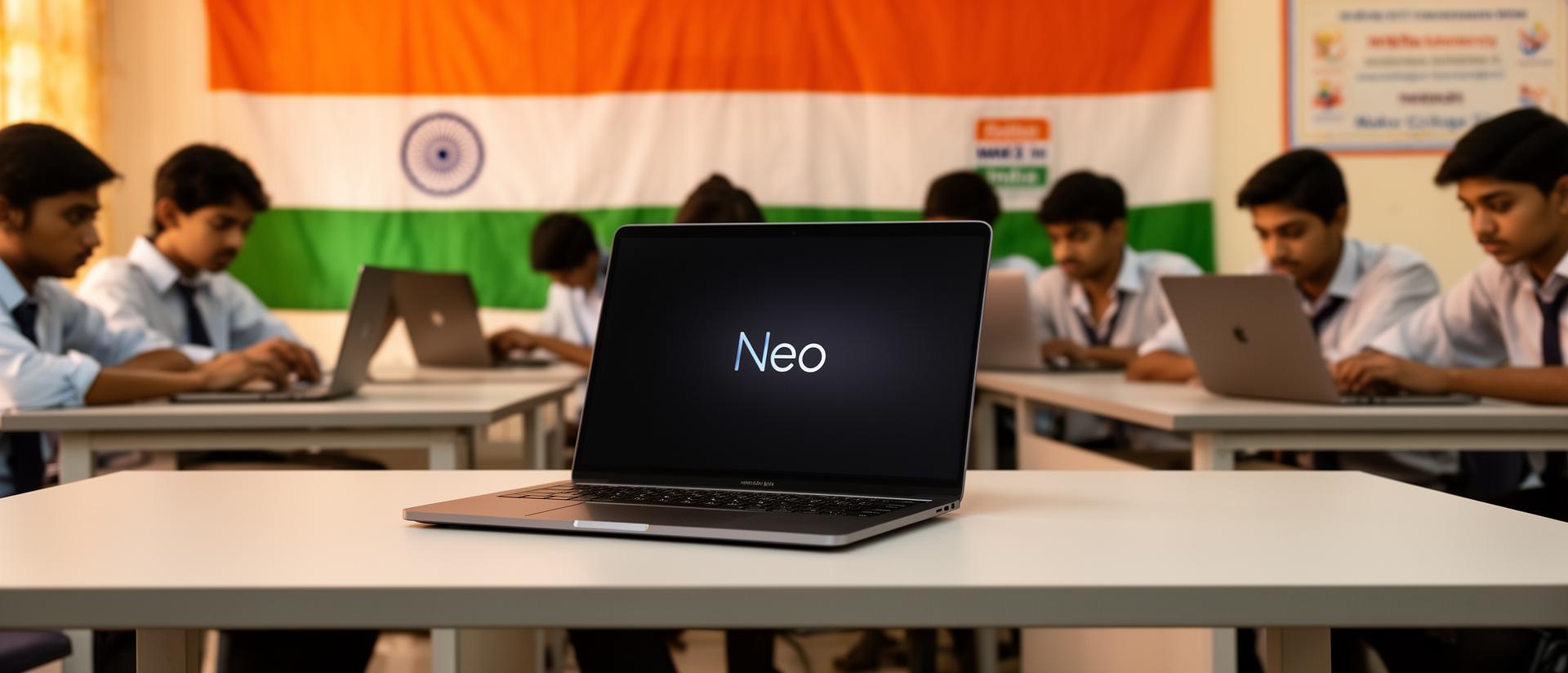
Apple has been steadily expanding its manufacturing footprint in India. iPhones have been assembled in India since 2017, and by 2025, India accounted for roughly 14% of global iPhone production. The MacBook Neo is widely expected to be the first Mac assembled in India — with Foxconn and Tata Electronics reportedly setting up Mac assembly lines in Tamil Nadu and Karnataka.
Local assembly means several things for India's economy. First, it creates thousands of skilled manufacturing jobs — not just assembly-line roles, but quality assurance, supply-chain management, logistics, and component testing positions. Second, it reduces Apple's dependence on China for Mac production, which aligns with India's goal of becoming a global electronics manufacturing hub under the Production-Linked Incentive (PLI) scheme.
The PLI scheme for IT hardware offers incentives of 1–4% on incremental production. For a product like the MacBook Neo, which could sell millions of units domestically and be exported to Southeast Asia, the Middle East, and Africa, the incentive structure makes Indian assembly economically attractive for Apple and strategically valuable for India.
Component localisation is the next frontier. While initial assembly will rely on imported components, India's growing ecosystem of PCB manufacturers, battery suppliers, and precision machining companies is positioning to enter Apple's supply chain. Companies like Tata Electronics, Dixon Technologies, and Syrma SGS are already investing in capabilities that could eventually supply display modules, battery cells, and even custom silicon packaging for Macs assembled in India.
Digital India: How an Affordable Mac Accelerates Digital Literacy
India's Digital India initiative aims to transform the country into a digitally empowered society and knowledge economy. A key bottleneck has been access to quality computing devices. While smartphones have achieved massive penetration, productive computing — coding, content creation, research, design — still requires a laptop or desktop.
The MacBook Neo, priced competitively with popular Windows laptops, gives Indian students and young professionals access to a platform known for security, privacy, and developer-friendliness. This matters for Digital India's goals in several ways.
Coding and app development: India produces the second-largest number of iOS apps globally, but most Indian developers work on borrowed or second-hand hardware. An affordable Mac with Xcode means more students can learn Swift, build iOS apps, and participate in Apple's developer economy — which pays Indian developers billions annually through the App Store.
Content creation: India's creator economy is booming — YouTube, Instagram Reels, podcasting, graphic design. macOS tools like iMovie, GarageBand, and Canva (which runs beautifully on Apple Silicon) lower the barrier to professional-quality content creation. The MacBook Neo's display quality and speakers make it a genuine content-creation station.
Cybersecurity and digital safety: As India digitises government services (DigiLocker, UPI, Aadhaar-based auth), citizen-facing devices need to be secure. macOS's sandboxed architecture, Gatekeeper, and built-in encryption provide a more secure computing environment than most alternatives in the same price range.
The Ecosystem Effect: Why macOS Loyalty Runs Deep
Apple's ecosystem is its strongest moat. Once a user has an iPhone and a Mac, the switching cost is not just financial — it is experiential. AirDrop lets you transfer files at gigabit speeds without Wi-Fi or Bluetooth pairing. Universal Clipboard lets you copy text on your iPhone and paste it on your Mac. Handoff lets you start an email on your phone and finish it on your laptop. Sidecar turns your iPad into a second display. Apple Watch unlocks your Mac automatically.
For students, these features are not gimmicks — they are workflow accelerators. A student can photograph handwritten notes on iPhone, AirDrop them to their Mac, and OCR them into searchable text in seconds. They can receive and respond to WhatsApp, iMessage, and email notifications from their Mac without picking up their phone during study sessions.
The MacBook Neo makes this ecosystem accessible at a price point where it was previously unavailable. That is not just a product launch — it is a market expansion strategy that could bring millions of new users into the Apple ecosystem in India alone.
Price Comparison: MacBook Neo vs Popular Windows Laptops in India
At the rumoured ₹64,900–₹74,900 price point, the MacBook Neo competes directly with the HP Pavilion 14 (₹62,000–₹70,000), Lenovo IdeaPad Slim 5 (₹65,000–₹75,000), ASUS Vivobook 14 (₹58,000–₹68,000), and Acer Swift Go 14 (₹60,000–₹72,000). On raw specs — RAM, storage, screen resolution — these Windows machines are comparable or even superior.
But the comparison breaks down on five dimensions where Apple dominates: battery life (22h vs 8–10h typical), build quality (aluminium vs plastic), trackpad quality (Force Touch glass vs plastic), software optimisation (native ARM vs x86 with efficiency trade-offs), and resale value (Macs retain 60–70% value after 3 years vs 30–40% for Windows laptops).
For a student buying one laptop to last through college, the 3-year total cost of ownership often favours the Mac despite the higher upfront price. Factor in free macOS updates for 7+ years (vs Windows 11 hardware cutoffs), no antivirus subscription needed, and Apple's education pricing, and the value proposition becomes even stronger.
Impact on India's Tech Workforce and Startup Ecosystem
India's startup ecosystem is the third-largest globally, and a disproportionate number of Indian startups build mobile-first products. iOS development requires a Mac — there is no alternative. By making Macs more affordable, the MacBook Neo removes a hardware barrier that has historically pushed Indian developers toward Android-only or web-only strategies.
More Indian developers building for iOS means more Indian apps in the global App Store, more revenue flowing into the Indian developer community, and stronger representation of Indian use cases (UPI integration, regional language support, India-specific AI models) in the Apple ecosystem.
For India's IT services industry — which employs over 5 million people — affordable Macs also mean that smaller companies and freelancers can equip their teams with the same hardware that global clients expect. This reduces the 'hardware gap' between Indian service providers and their US/EU counterparts.
Environmental and Sustainability Angle
Apple has committed to making every product carbon-neutral by 2030. The MacBook Neo is expected to use 100% recycled aluminium in its enclosure, recycled rare earth elements in its magnets, and 100% recycled tin in its solder. The packaging is fibre-based with no plastic wrap.
For India — where e-waste is a growing concern — a laptop designed to last 7+ years with full software support, built from recycled materials, and backed by Apple's trade-in and recycling programmes is a meaningful step toward sustainable computing. The longer replacement cycle alone reduces e-waste generation compared to budget laptops that need replacing every 2–3 years.
Local assembly further reduces the carbon footprint of each unit sold in India by eliminating the shipping emissions from China. This aligns with India's Nationally Determined Contributions under the Paris Agreement and supports the broader sustainability goals of Digital India.
What This Means for Digital Koncept and Our Clients
At Digital Koncept, we see the MacBook Neo as an accelerator for the digital services we provide. More affordable Macs mean more Indian businesses and entrepreneurs can access professional-grade tools for web development, design, content creation, and app development — all services we specialise in.
For our clients in Delhi-NCR and across India, the expanding Apple ecosystem creates new opportunities: iOS app development, Apple Business Manager integrations, and optimised web experiences for Safari and WebKit. As more Indian users adopt macOS, businesses need to ensure their digital presence works flawlessly across Apple devices — and that is exactly where we come in.
The MacBook Neo is not just a laptop launch. It is a signal that premium computing is becoming democratised in India, and the businesses that adapt their digital strategies to this shift will have a significant competitive advantage.