How Indian SMBs Can Use AI Agents to Automate Customer Support in 2026
Why AI-Powered Customer Support Is No Longer Optional for Indian SMBs
India has over 63 million SMBs — and the vast majority still handle customer support through a handful of staff juggling phone calls, WhatsApp messages, emails, and walk-ins simultaneously. The result is predictable: long response times, inconsistent answers, missed queries after business hours, and burnt-out teams. In 2026, customers expect instant, accurate responses around the clock — and AI agents make that possible even for a 5-person team.
An AI customer support agent is not a simple FAQ chatbot. It is a conversational system that understands natural language, maintains context across multiple messages, accesses your business data (products, orders, policies) in real time, and can take actions — book appointments, process refunds, escalate to humans — without anyone writing rigid if-then scripts. The technology has matured dramatically, and the costs have dropped to a level where even a neighbourhood clinic or a D2C brand doing ₹10 lakh/month can afford it.
What AI Agents Can Actually Do for Customer Support
Answer product and service questions instantly: AI agents trained on your catalog, pricing, and FAQs can handle 70–85% of incoming queries without human intervention. Whether a customer asks 'Do you deliver to Noida?' or 'What's the return policy for electronics?', the agent responds in seconds with accurate, up-to-date information.
Handle order tracking and status updates: By integrating with your order management system or logistics API (Shiprocket, Delhivery, etc.), the AI agent can tell customers exactly where their order is, provide estimated delivery dates, and proactively notify them about delays — eliminating the #1 support query for e-commerce businesses.
Book appointments and reservations: For clinics, salons, consultancies, and restaurants, AI agents can check availability, book slots, send confirmations, and handle rescheduling — all through WhatsApp, Telegram, or your website chat widget.
Process returns, refunds, and complaints: With proper guardrails, AI agents can initiate return requests, verify order details, and route complex complaints to the right human agent with full context — so the customer doesn't have to repeat themselves.
Multilingual support: India's linguistic diversity is a massive challenge for small support teams. AI agents powered by modern LLMs can converse fluently in Hindi, Tamil, Telugu, Bengali, Marathi, and 20+ other Indian languages — switching mid-conversation if the customer prefers.
Choosing the Right AI Model for Your Budget
Not all AI models are created equal, and cost varies dramatically. Here's a practical framework for Indian SMBs: For simple Q&A and FAQ-style support, lightweight models like Google Gemini Flash or GPT-4o-mini deliver excellent results at very low cost — often under ₹500/day for businesses handling 200–500 queries. These models are fast, handle Indian languages well, and are more than adequate for structured support flows.
For complex, multi-turn conversations that require reasoning (e.g., troubleshooting technical products, handling nuanced complaints, or comparing product options), use more capable models like Gemini Pro or GPT-4o. These cost more per query but dramatically reduce the need for human escalation.
The smartest approach is a tiered system: route simple queries to a cheap, fast model and only escalate to an expensive model when the conversation requires deeper reasoning. This hybrid approach can cut AI costs by 60–70% compared to using a single premium model for everything.
Where to Deploy Your AI Agent: Channels That Matter
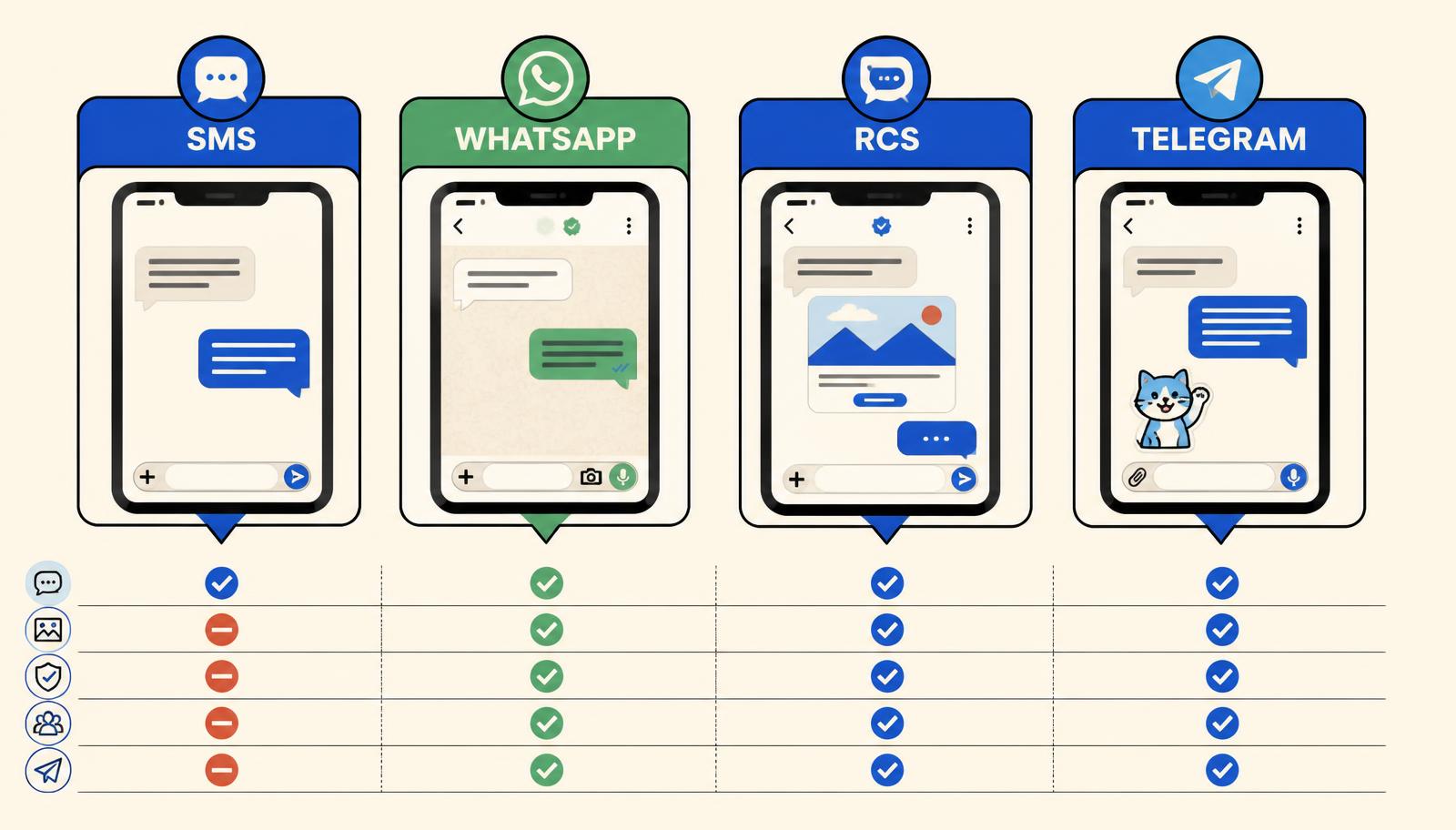
WhatsApp is the undisputed king of customer communication in India. Over 500 million Indians use WhatsApp daily, and most customers prefer it over email or phone calls. Deploy your AI agent on WhatsApp using the Business API — it handles text, images, documents, location sharing, and interactive buttons natively. The catch: WhatsApp charges per conversation (roughly ₹0.35–₹0.85 depending on category), so optimize your agent to resolve queries in as few messages as possible.
Website live chat is essential for businesses that drive traffic through Google or social media. Embed a chat widget (Intercom-style) that connects to the same AI backend. The advantage: no per-message cost, rich formatting options, and the ability to show product carousels, images, and links inline.
Telegram is ideal for tech-savvy audiences and businesses that want zero messaging costs. The Bot API is completely free, supports rich interactions (inline keyboards, mini apps, payments), and has no rate limits for normal usage. If your customer base skews younger or more digital-native, Telegram is a strong secondary channel.
Instagram DMs and Facebook Messenger are increasingly important for D2C and retail brands. Meta's APIs allow AI-powered auto-replies on both platforms, turning social media inquiries into structured support conversations.
Building Your AI Support Agent: Architecture Overview
A production-grade AI support agent has five core components: Channel connectors (WhatsApp API, Telegram Bot API, website WebSocket) that receive and send messages. A conversation manager that tracks session state, user history, and context across messages. A knowledge base — your product catalog, FAQs, policies, and order data — indexed and searchable by the AI. The LLM layer that generates responses using the knowledge base and conversation context. And an action layer that can execute tasks (book appointments, check order status, create tickets) by calling your internal APIs.
For most Indian SMBs, the simplest architecture is: Supabase or Firebase for the database and user session management, an edge function or lightweight Node.js server for the conversation manager, a vector database (Pinecone, Supabase pgvector, or Qdrant) for the knowledge base, and the LLM API called on each message with relevant context injected into the prompt.
Start with a retrieval-augmented generation (RAG) approach: when a customer asks a question, search your knowledge base for relevant documents, inject the top results into the LLM prompt, and let the model generate a grounded, accurate answer. This prevents hallucination and ensures responses reflect your actual business data.
Training Your Agent on Your Business Data
The difference between a generic chatbot and a useful AI agent is business-specific knowledge. Gather all your support content: product descriptions, pricing sheets, shipping policies, return/refund rules, common customer complaints and their resolutions, appointment booking rules, and any scripts your human agents currently follow.
Convert this into clean, structured text documents. Break them into logical chunks (one topic per chunk, 200–500 words each) and embed them using an embedding model (OpenAI text-embedding-3-small or Google's embedding model). Store the embeddings in a vector database for fast similarity search.
Test the agent thoroughly with real customer queries before going live. Create a test set of 50–100 actual questions from your support history and verify that the agent's answers are accurate, complete, and appropriately toned. Pay special attention to edge cases: what happens when the agent doesn't know the answer? It should say 'I'm not sure about that — let me connect you with our team' rather than guessing.
Human Handoff: When AI Should Step Aside
Even the best AI agent cannot handle every situation. Build a robust escalation system that transfers the conversation to a human agent when: the customer explicitly asks to speak to a person, the AI detects high frustration or anger (sentiment analysis), the query involves sensitive topics (billing disputes, legal matters, safety concerns), the AI has low confidence in its answer (below a configurable threshold), or the conversation exceeds a certain number of turns without resolution.
The handoff must be seamless. The human agent should receive the full conversation history, the customer's profile data, and the AI's assessment of the issue — so the customer never has to repeat themselves. Tools like Freshdesk, Zendesk, or even a simple Slack integration can manage the human queue.
Track your escalation rate as a key metric. A well-tuned AI agent should handle 70–85% of queries autonomously. If your escalation rate is above 30%, your knowledge base needs improvement or your agent's prompts need refinement.
Cost Analysis: AI Support vs. Human Support for Indian SMBs
A full-time customer support executive in Delhi-NCR costs ₹15,000–₹25,000/month (salary + overhead). They work 8–9 hours/day, handle 40–60 queries, need training, take leaves, and can only speak 1–2 languages fluently. To provide 24/7 support, you need at least 3 shifts — meaning 3x the cost.
An AI agent costs roughly ₹5,000–₹15,000/month in API and infrastructure costs (depending on volume) and operates 24/7/365 in 20+ languages with zero sick days. It handles 200–500+ queries per day consistently, and its performance improves over time as you refine the knowledge base.
The math is clear: for an SMB handling 100+ support queries daily, an AI agent pays for itself within the first month. But the goal is not to replace all human agents — it's to let AI handle the repetitive 80% so your human team can focus on complex, high-value interactions that actually require empathy and judgment.
Real-World Use Cases: Indian SMBs Already Using AI Agents
D2C fashion brands are using AI agents on WhatsApp to handle size queries, return requests, and order tracking — reducing support tickets by 65% and response times from 4 hours to under 30 seconds.
Dental clinics and dermatology practices in metro cities deploy AI agents for appointment booking, pre-visit instructions, and post-treatment follow-ups. Patients can book a cleaning appointment at 11 PM on a Sunday — something that was impossible with a receptionist-only model.
EdTech platforms use AI agents to answer course queries, handle enrollment questions, share demo class links, and qualify leads — converting 3x more inquiries into paid enrollments compared to a manual callback system.
Local restaurants and cloud kitchens integrate AI agents with their POS and delivery systems to handle order modifications, delivery ETAs, and complaint resolution — freeing up kitchen staff from phone duty during peak hours.
Compliance and Data Privacy Considerations
India's Digital Personal Data Protection Act (DPDPA) 2023 applies to AI agents that collect and process customer data. Key requirements: obtain clear consent before collecting personal information, provide a privacy notice explaining how data is used, allow customers to request deletion of their data, and implement reasonable security measures to protect stored data.
If your AI agent handles payment information, health data, or financial details, additional safeguards apply. Never store sensitive data in conversation logs without encryption. Use tokenization for payment card numbers and mask Aadhaar/PAN details in support transcripts.
Disclose that the customer is interacting with an AI agent. Transparency is both a legal requirement under emerging regulations and a trust-building practice. Most Indian customers are comfortable with AI support as long as they know they can reach a human when needed.
Getting Started: A 30-Day Implementation Plan
Week 1 — Audit and Prepare: Analyze your last 500 support queries. Categorize them by type (product info, order status, complaints, bookings, etc.). Identify which categories are repetitive and suitable for AI automation. Gather all knowledge base content.
Week 2 — Build and Train: Set up the AI agent architecture, embed your knowledge base, configure the LLM with a carefully crafted system prompt that reflects your brand voice, and build the escalation workflow. Test with your internal team.
Week 3 — Soft Launch: Deploy on one channel (start with website chat or Telegram — lower stakes than WhatsApp). Route 20–30% of incoming queries to the AI agent while humans monitor every conversation. Collect feedback, fix knowledge gaps, and tune the prompts.
Week 4 — Scale: Increase AI routing to 80–100% on the first channel. Deploy on WhatsApp. Set up monitoring dashboards for resolution rate, escalation rate, customer satisfaction scores, and cost per query. Iterate weekly based on data.
Common Pitfalls and How to Avoid Them
Launching without a knowledge base: An AI agent without business-specific data is just a generic chatbot that will frustrate customers with vague, unhelpful answers. Invest time upfront in building a comprehensive, accurate knowledge base.
Over-promising AI capabilities: Don't market your AI agent as a replacement for human support. Position it as 'instant answers for common questions' with easy access to human agents for complex issues. Setting realistic expectations prevents customer backlash.
Ignoring conversation analytics: Every AI conversation is a data goldmine. Track which questions the agent handles well, where it fails, what customers ask that isn't in your knowledge base, and which escalations could have been avoided. Review this data weekly.
Not updating the knowledge base: Products change, policies evolve, prices update. If your AI agent's knowledge base is stale, it will give wrong answers — which is worse than no answer at all. Assign someone to update the knowledge base whenever business information changes.
Final Takeaway: Start Small, Scale Fast
AI-powered customer support is not a luxury for large enterprises anymore. In 2026, the tools are accessible, the costs are manageable, and the ROI is proven. An Indian SMB spending ₹10,000–₹15,000/month on AI infrastructure can deliver the same 24/7 multilingual support experience that Fortune 500 companies offer — leveling the playing field in a way that was unthinkable even two years ago.
The key is to start with a focused scope: pick your highest-volume, most repetitive support category, build an AI agent that handles it exceptionally well, measure the impact, and then expand. Within 90 days, you'll wonder how you ever managed without it.
If you'd rather skip the build phase entirely, our team designs, deploys, and manages production-grade AI support agents — from knowledge base curation and LLM fine-tuning to WhatsApp API integration and ongoing optimization. Let us handle the technology while you focus on growing your business.
Get a Custom AI Agent Built for Your Business
We design, deploy, and manage production-grade AI support agents — from knowledge base curation and LLM integration to WhatsApp API setup, multilingual training, and ongoing optimization.
Explore AI Agent Development →