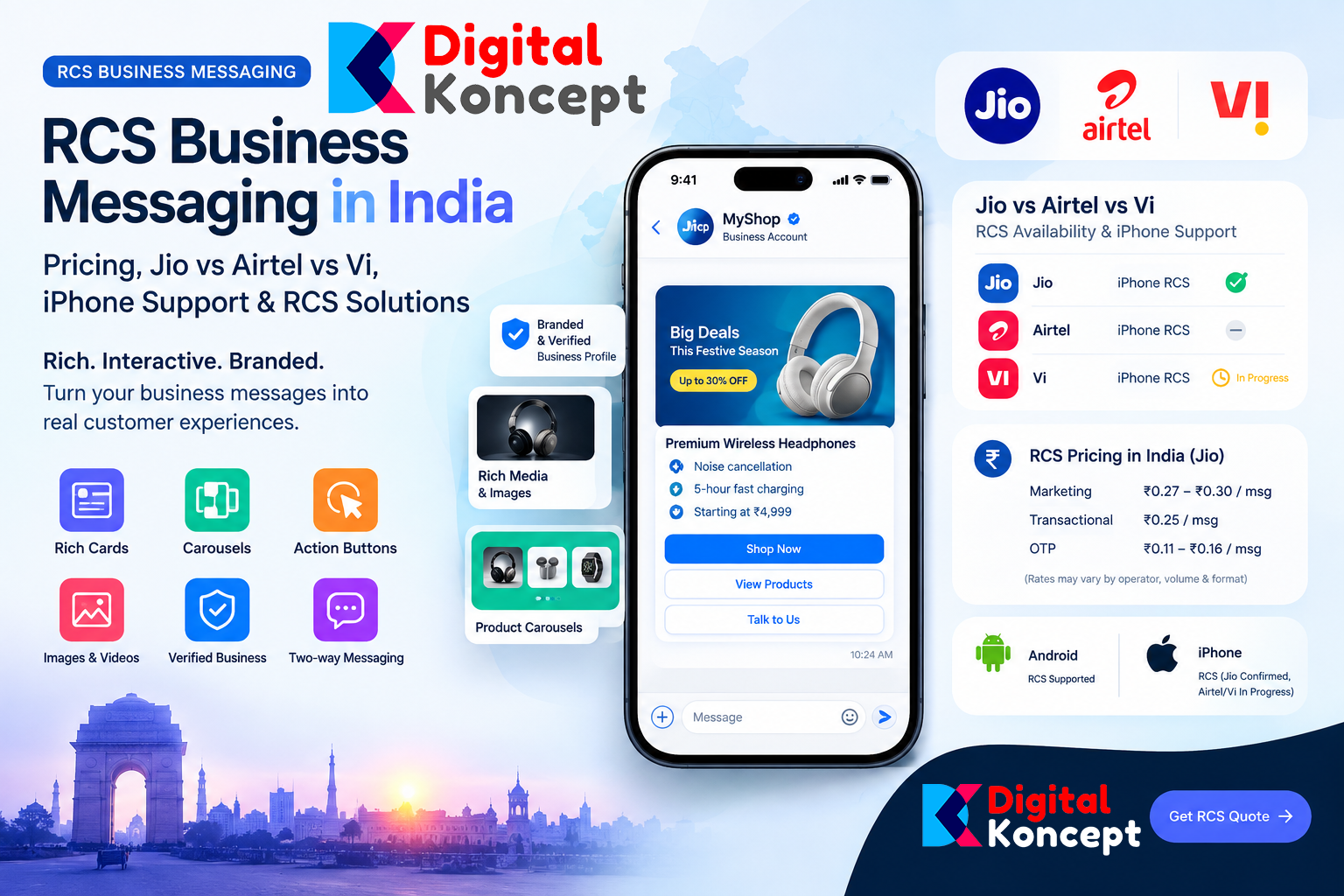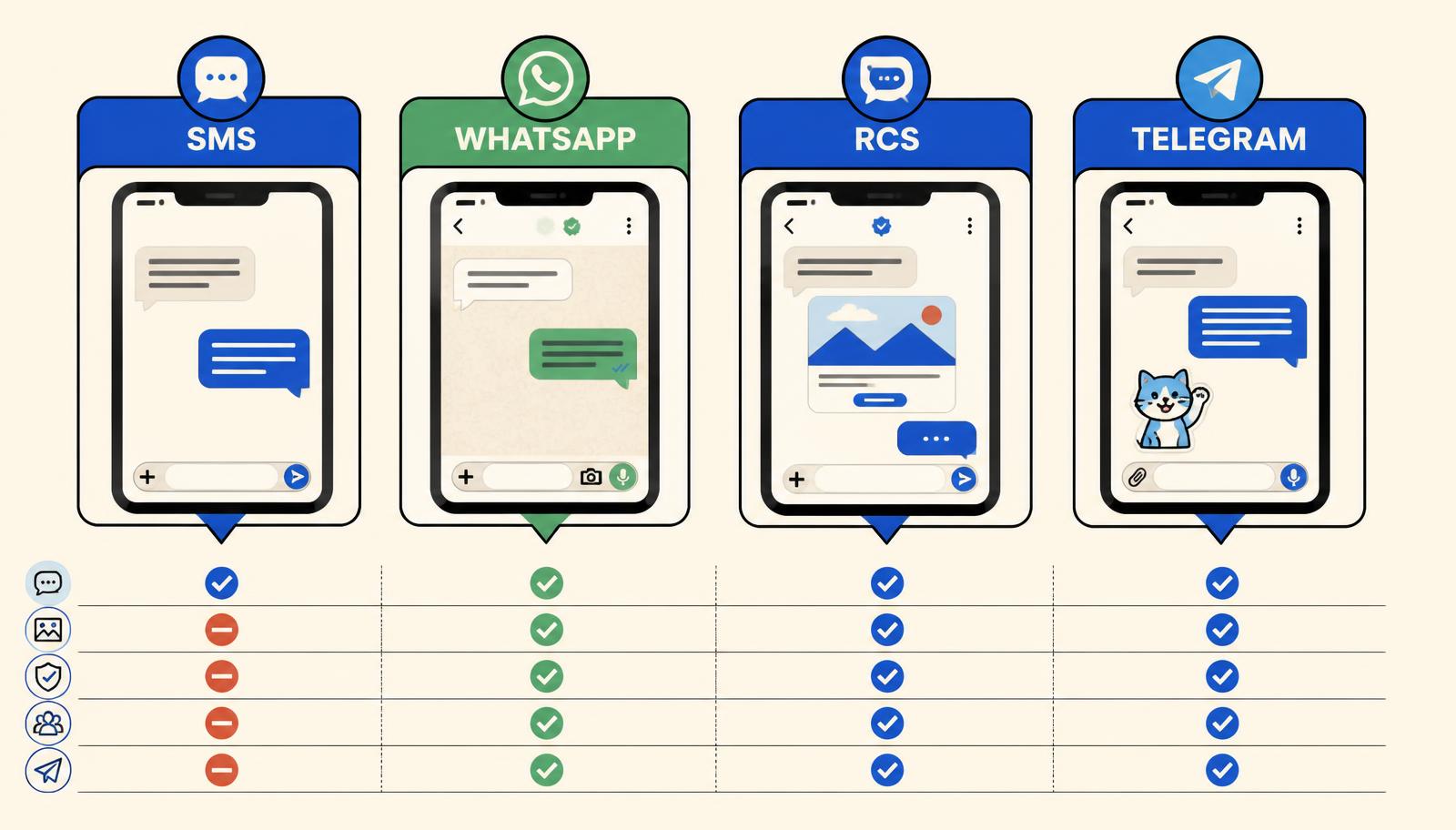
SMS vs WhatsApp vs RCS vs Telegram in India (2026)
Business Messaging Channels for India's Service Sector
Every Indian service business that sends a message to a customer is making a channel decision, whether it realises it or not. That choice determines delivery rates, cost per conversation, regulatory exposure and customer experience. In 2026, four channels dominate business messaging in India: transactional SMS, WhatsApp Business API (WABA), RCS (Rich Communication Services) delivered through Google's RBM platform, and Telegram bots and channels.
The naive approach is to pick the cheapest channel and blast everyone. That approach is exactly why so many campaigns produce 0.2% click-through rates, DND complaints, template rejections and blocked sender IDs. The better approach is to map each channel against three things: the actual reachable user base, the message category (service, transactional or promotional), and the compliance regime that governs that category.
This guide does that mapping in detail, using real reach numbers, cost bands, and channel limitations that most vendor decks conveniently leave out. By the end you will have a practical fallback waterfall you can implement on any CPaaS platform, plus sector-specific recommendations for government bodies, PSUs, banks, large corporates, D2C brands and small businesses.
The Real User Base in India: 1.26 Billion Subscribers, Four Very Different Audiences
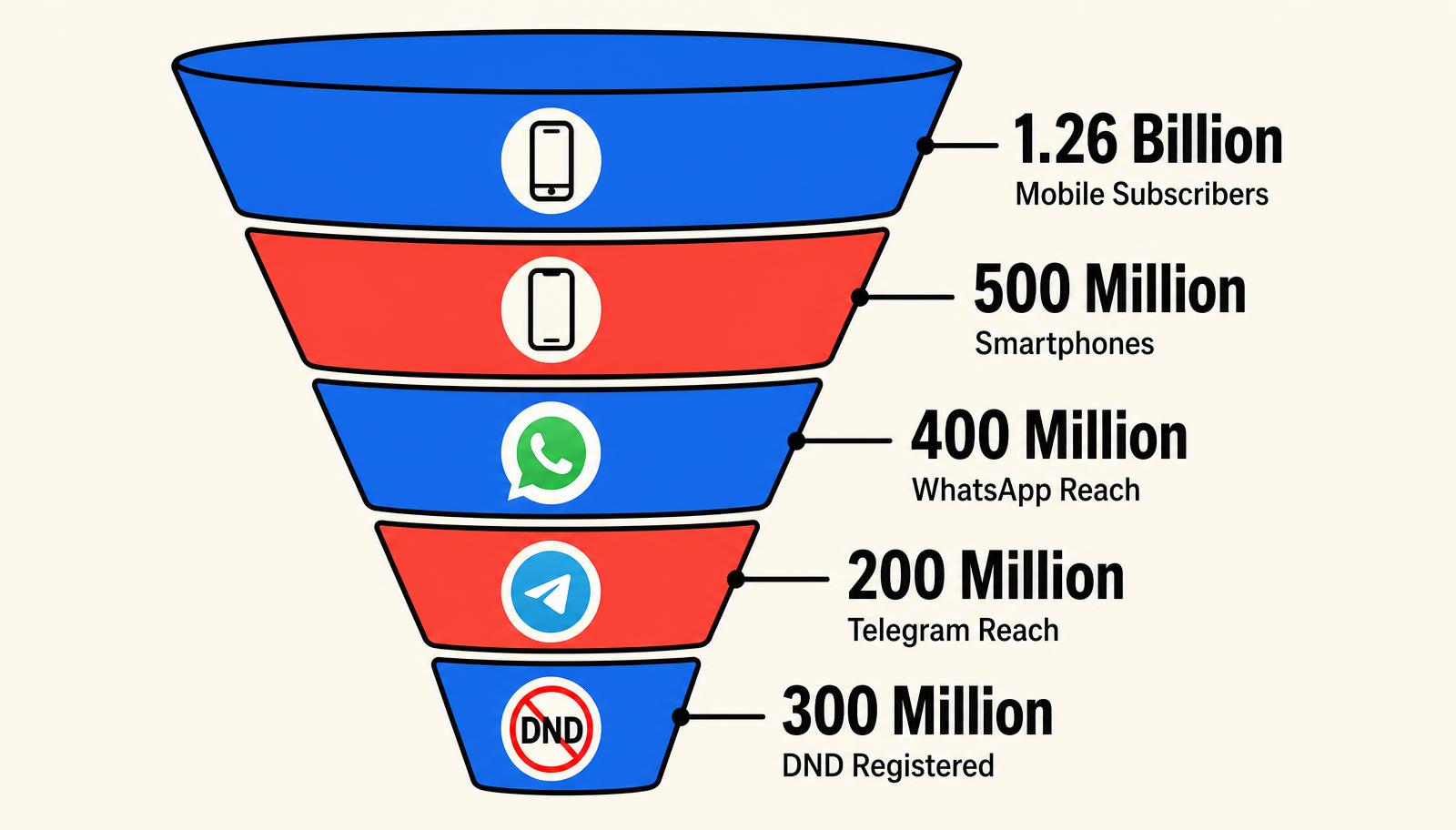
India has roughly 1.26 billion active mobile subscribers. That single number is the ceiling for SMS, and it is the reason SMS still exists as the universal fallback. Every one of those handsets — feature phone, entry-level Android, flagship iPhone — can receive a text message with no app installation, no internet connection and no user opt-in step.
Smartphone penetration sits at approximately 500 million devices. This is the ceiling for every app-based and IP-based channel. WhatsApp reaches roughly 400 million Indian users, which makes it the single largest app-based messaging surface in the country and explains why WABA has become the default choice for service conversations. Telegram reaches an estimated 150–200 million Indian users, skewed toward younger, urban, tech-forward and crypto/gaming/education communities.
RCS reach is the most misunderstood number in the market. RCS is not an app you install — it is an upgrade layered on top of the default messaging app. In India, Google Messages is the default SMS app on most Android devices, and Samsung Messages covers most of the remaining volume. Both support RCS, which means the practical RCS reachable base in India is a large and rapidly growing subset of that 500 million smartphone pool — typically 250–350 million verified-sender-capable handsets depending on operator and OEM rollout.
Layered across all of this is DND. Roughly 300 million Indian subscribers are registered on the Do Not Disturb (DND) list under TRAI's TCCCPR framework. This does not block transactional or service messages sent on registered templates and headers, but it fundamentally caps how large your legally addressable promotional SMS audience actually is. Any promotional SMS plan built on the 1.26 billion number without DND scrubbing is a plan built on a fantasy.
Cost Per Message: The Numbers That Decide Your Channel Mix
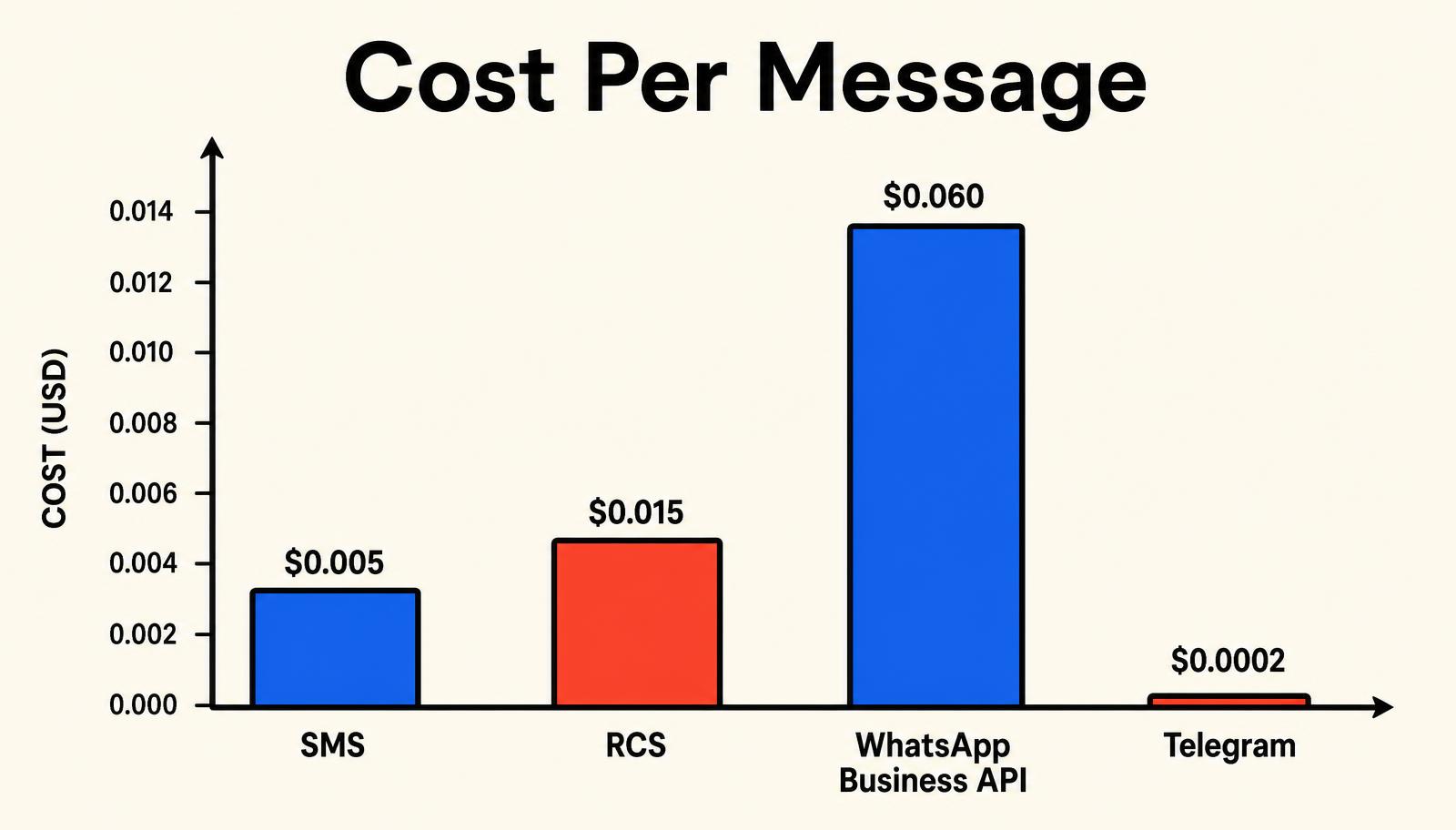
Cost differences between these channels are not marginal — they are order-of-magnitude. Understanding the bands matters more than chasing exact per-unit rates, because rates move with volume commitments, operator agreements and Meta's periodic pricing revisions.
SMS in India typically lands between ₹0.12 and ₹0.25 per transactional message, with promotional SMS priced slightly higher. It is the cheapest per-unit channel at scale, but it carries no rich media, no buttons and no read receipts, so cost per conversion is often far worse than cost per message suggests.
RCS sits in a similar or slightly higher band than SMS per message — typically ₹0.15 to ₹0.60 depending on whether the message is basic, single-media or a rich card carousel. Because RCS delivers images, carousels, suggested replies and verified branding inside the native inbox, its effective cost per click is usually dramatically lower than SMS. This is the single strongest commercial argument for RCS in 2026.
WhatsApp Business API is priced per conversation rather than per message, and Meta's category split matters enormously. Utility and authentication conversations are inexpensive and, in many cases, free when initiated inside a customer service window. Marketing conversations are the most expensive of the four channels — commonly ₹0.70 to ₹1.00+ per conversation in India. WhatsApp is therefore excellent value for service and terrible value for high-volume cold promotion.
Telegram is effectively free. Bot API messages carry no per-message carrier or platform fee, so your only real cost is development and hosting. The catch is that Telegram reach is opt-in only: a user must have joined your channel or started your bot. It cannot be used for cold outreach at all, which makes it a retention and community channel rather than an acquisition channel.
Transactional Messaging for Indian Service Businesses
Service and transactional messages — OTPs, order confirmations, delivery updates, payment receipts, appointment reminders, KYC alerts and ticket status — are the highest-value messages a business sends because the customer is actively waiting for them. Banks and fintech firms need secure authentication and payment alerts; hospitals and clinics need appointment reminders; logistics and travel providers need time-sensitive status updates; education businesses need admission and fee notifications; utilities and local service companies need billing and booking alerts. Delivery reliability matters more than beauty.
SMS remains the gold standard for OTP and authentication because of universal reach and carrier-grade delivery independent of internet connectivity. If a customer is on a 2G fallback in a basement, SMS still lands. For any authentication flow, SMS should remain in the mix as either the primary or the final fallback.
WhatsApp Business API is the best channel for rich service conversations. Utility templates deliver order updates with images, PDFs and buttons; the customer can reply and reach a human or a bot in the same thread; and the 24-hour customer service window makes two-way support cheap. For post-purchase experience — shipping, returns, service tickets, appointment rescheduling — WABA outperforms every other channel on both satisfaction and cost.
RCS excels at branded transactional messaging where trust is the deciding factor. A verified sender name, verified logo and brand colour inside the native messaging inbox visibly separates a genuine bank alert from a phishing attempt. For banks, PSUs, insurers and government departments fighting impersonation fraud, that verified identity is worth more than any feature list.
Telegram is not appropriate as a primary transactional channel for regulated communication. It is excellent, however, for internal alerts, developer and ops notifications, dealer and distributor networks, and any high-frequency update stream where users have explicitly subscribed and expect volume.
Promotional and Marketing Communication: Where Costs and Rules Bite
Promotional messaging is where channel choice separates profitable campaigns from expensive noise. The regulatory and commercial constraints differ sharply across the four channels.
Promotional SMS in India must run on registered headers and registered content templates under TCCCPR, must respect DND preferences, and is generally restricted to permitted time windows. With 160 characters, no media and heavy competition in a crowded inbox, promotional SMS is best used for short, urgent, high-relevance nudges — expiry reminders, flash windows, limited-slot alerts — rather than storytelling.
RCS is the strongest promotional channel available in India today for reach-versus-richness. Carousels of products, tappable suggested replies, deep links to app or web checkout, read receipts and typing indicators — all delivered natively without app installation. Combined with SMS-like pricing, RCS gives the best blended cost per click of any channel for mass promotion in 2026.
WhatsApp marketing templates work extremely well but must be used surgically. Meta enforces template approval, per-user marketing frequency capping, and quality ratings that degrade when users block or report your number. High-volume cold marketing on WABA is expensive, risks quality-rating downgrades and can throttle your messaging tier. Reserve WhatsApp marketing for segmented, high-intent audiences: abandoned carts, repeat buyers, loyalty tiers and re-engagement of known customers.
Telegram is the cheapest promotional channel per rupee, with zero send cost and no template approval, but only within your existing subscriber base. Broadcast channels, community groups and bot-driven drip sequences give near-unlimited creative freedom. Use Telegram to monetise an audience you already own; never plan acquisition around it.
Limitations You Must Plan Around
RCS has genuine gaps. It does not work inside third-party messaging apps — if a user's default SMS app is Truecaller Messaging, or any OEM or third-party app that has not implemented RBM, your RCS message will not render as RCS and must fall back to SMS. RCS also depends on the handset, the default messaging app and operator provisioning being aligned; brand and agent verification through Google RBM takes time; and while Apple has enabled RCS on iOS, branded RBM business messaging support on iPhone in India remains partial compared to Android. Plan RCS with an automatic SMS fallback, always.
SMS limitations are structural: 160 characters, no media, no interactivity, no read receipts, aggressive spam filtering, DND scrubbing obligations, and header and template registration overhead. It also suffers the lowest engagement of the four channels because users have learned to ignore the SMS inbox.
WhatsApp limitations are commercial and policy-driven. Template pre-approval, category-based pricing, marketing frequency caps, quality ratings, phone number migration friction, and India's evolving SIM-binding verification rules all constrain how aggressively WABA can be used. Blocks and reports directly damage your ability to send at all — a risk SMS simply does not have.
Telegram limitations are about permission and perception. There is no cold reach whatsoever, no carrier-grade delivery guarantee for regulated notifications, and in India the audience skews urban and younger. For BFSI and government use cases it is generally unsuitable as a compliance-grade channel of record.
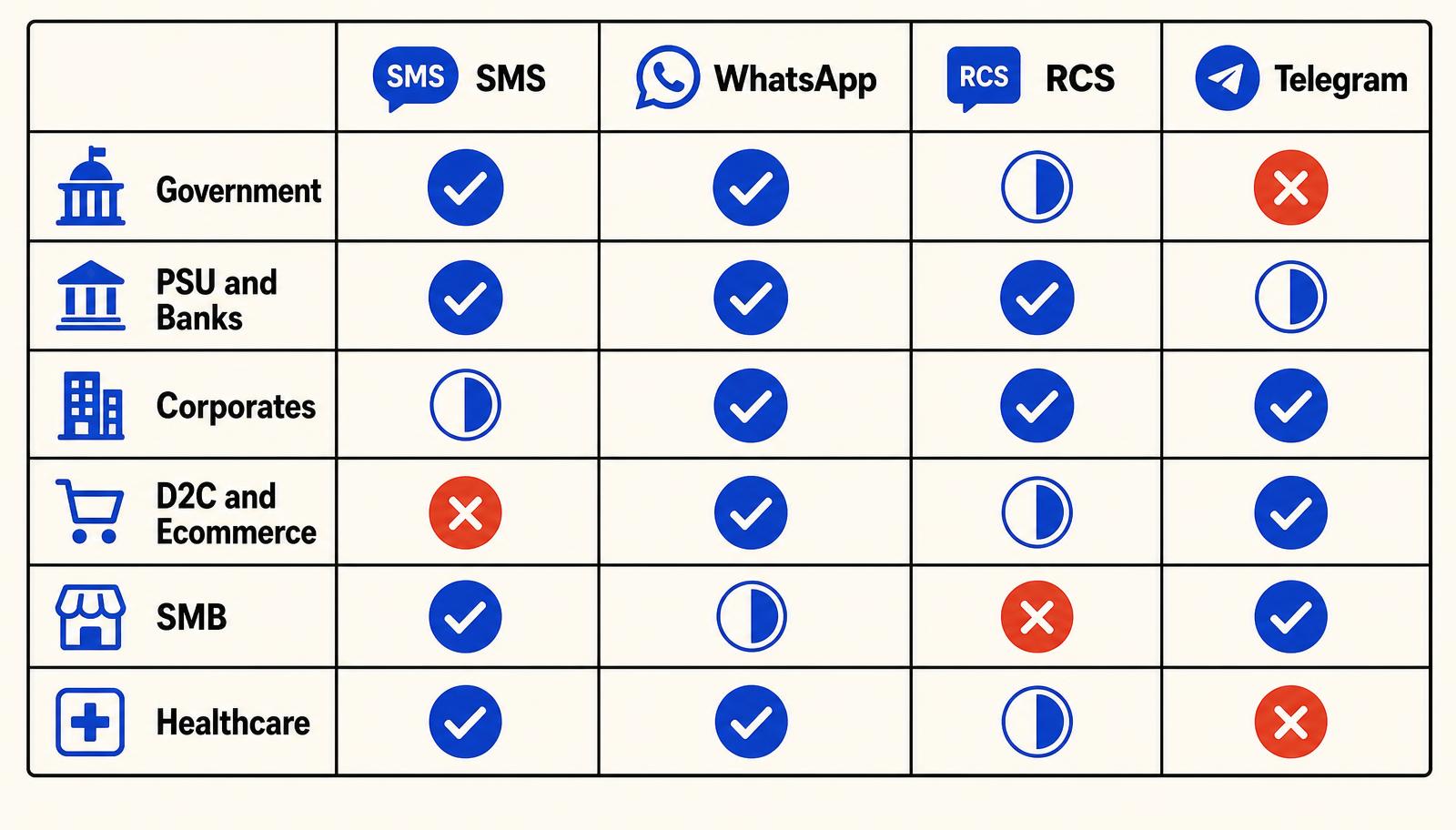
Best Messaging Channels by Indian Service Sector
Government departments and civic bodies should lead with SMS for universal reach — scheme notifications, exam results, subsidy credits and public advisories must reach feature phones and rural subscribers. RCS becomes powerful as a trust layer for verified citizen communication where the recipient base is smartphone-heavy, and WhatsApp works well for two-way grievance redressal and document delivery. Telegram is best kept to internal and departmental coordination.
PSUs, banks, insurers and NBFCs need verified identity above everything, because impersonation fraud is the dominant threat. The right stack is RCS verified sender for branded alerts and statements, WhatsApp utility templates for statements, service requests and document collection, and SMS as the guaranteed fallback for OTP and mandatory regulatory notifications.
Large corporates and enterprises benefit most from a full CPaaS orchestration layer: a single API that routes each message by category, checks channel capability per user, and applies a fallback waterfall automatically. This is where cost savings compound — routing utility traffic to the cheapest capable channel across millions of messages per month is a direct margin improvement.
D2C and e-commerce brands should treat WhatsApp as the conversation and retention engine, RCS as the catalogue and promotion engine, SMS as the delivery-critical fallback, and Telegram as the community and loyalty layer for their most engaged buyers.
Healthcare providers can use WhatsApp for appointment conversations, RCS for branded reminders and SMS as the delivery fallback. Logistics and travel businesses can combine WhatsApp utility updates with RCS rich cards and transactional SMS for urgent status alerts. Schools, universities and EdTech providers can use WhatsApp for student support, SMS for fee and admission deadlines, and Telegram for opted-in learning communities. Utilities, home services and other local service businesses get the fastest return from WhatsApp for enquiries and bookings, with RCS for branded campaigns and SMS for critical notices. Telegram suits coaching institutes and content businesses with community-driven audiences.
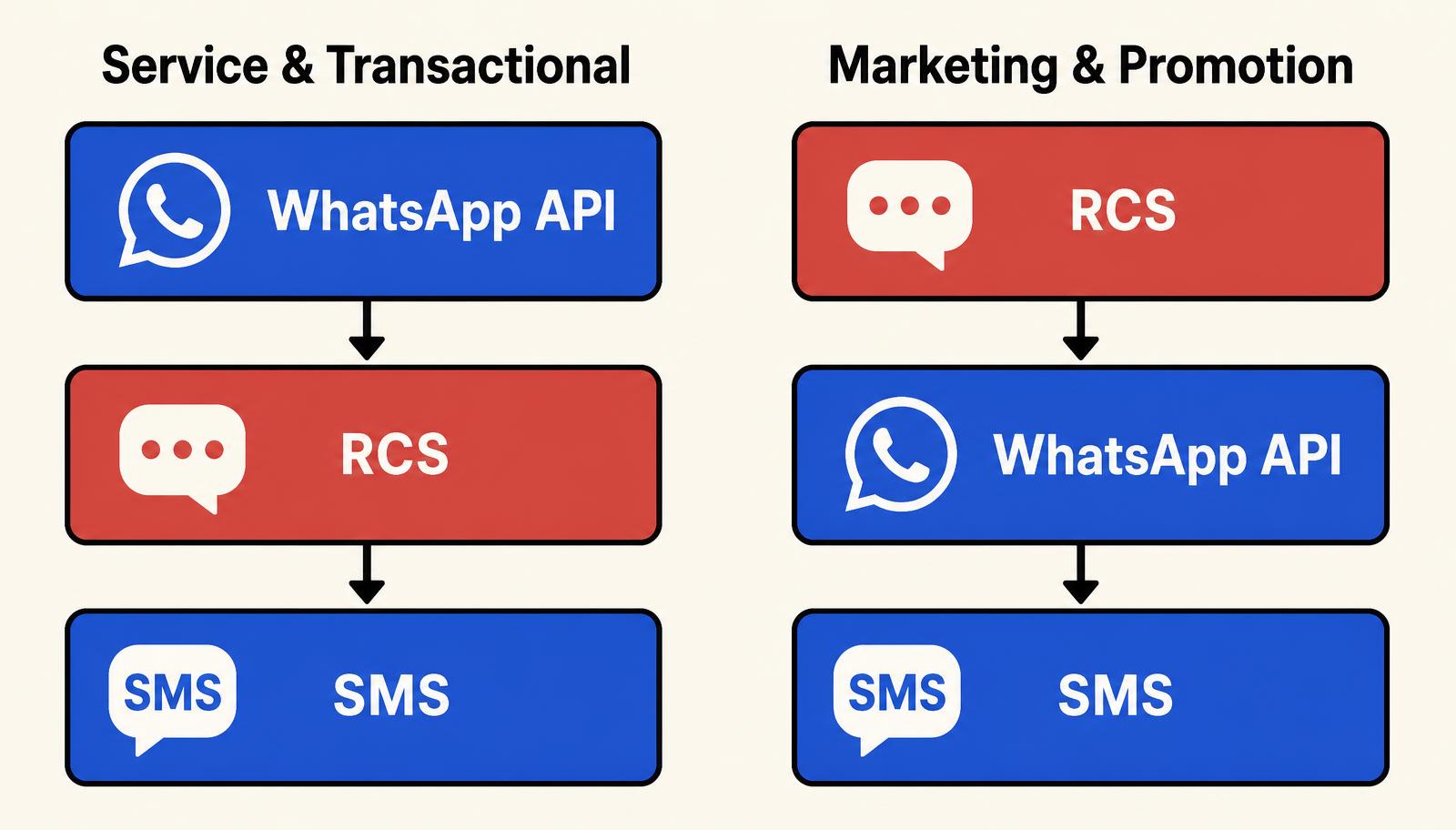
The Best Practical Solution: A Two-Track Fallback Waterfall
After stripping away vendor positioning, the practical answer is not one channel — it is two ordered waterfalls, one for service and one for marketing, executed through a single orchestration layer.
For service and transactional traffic, the order is WhatsApp Business API first, RCS second, SMS third. WhatsApp is chosen first because utility conversations are inexpensive, richly formatted and two-way. If the user has no WhatsApp presence or the template fails, RCS attempts delivery with verified branding. If RCS is unavailable — third-party default SMS app, unprovisioned handset, iOS gaps — SMS guarantees the message lands. For pure OTP and authentication, invert this and lead with SMS for latency and reliability.
For marketing and promotional traffic, the order is RCS first, WhatsApp Business API second, SMS third. RCS leads because it delivers app-grade richness at SMS-grade pricing across a large Android base. WhatsApp handles the high-intent, well-segmented remainder where a conversation is worth the marketing conversation fee. SMS mops up the non-RCS, non-WhatsApp tail with a short, sharp message. Telegram runs in parallel to both tracks as a zero-cost broadcast layer to your owned subscriber base.
Two operational rules make this work. First, maintain channel capability data per contact — RCS capability, WhatsApp presence, DND status, opt-in source and timestamp — and refresh it continuously. Second, set a fallback timeout per hop rather than waiting for terminal failure; if RCS has not been delivered within a defined window, drop to the next channel so time-sensitive messages are not stranded.
Measuring What Actually Matters
Delivery rate alone is a vanity metric. The metrics that decide channel budget are cost per delivered message, cost per read, cost per click and cost per conversion, tracked by channel and by message category. RCS almost always wins on cost per click for promotion; WhatsApp almost always wins on cost per resolved service conversation; SMS wins on guaranteed delivery for authentication; Telegram wins on cost per engaged subscriber.
Instrument every hop of the waterfall. Log which channel attempted first, which channel actually delivered, and where conversions originated. Within a quarter you will have enough data to re-order your waterfall per segment — and that segment-level tuning typically produces larger savings than any per-message rate negotiation.
Finally, watch your quality signals. WhatsApp quality rating, RCS agent verification status, SMS complaint and DND scrub rates, and Telegram unsubscribe velocity are all early warning systems. A degrading quality score is a forecast of falling reach, and reach is the only thing every one of these channels is ultimately selling you.
How Digital Koncept Implements This Stack
Digital Koncept builds and operates multi-channel messaging stacks for businesses across Delhi-NCR and India — WhatsApp Cloud API and WABA panels, RCS messaging through verified RBM agents, bulk and transactional SMS with DND scrubbing, Telegram bots, and the CPaaS orchestration layer that ties them together with automatic fallback.
That includes the unglamorous parts that determine whether a stack actually works: brand and agent verification, bot and template approval, header and template registration, consent capture and audit trails, capability data hygiene, and white-labelled reseller panels for agencies that want to sell RCS and WhatsApp under their own brand.
If you are choosing between SMS, WhatsApp, RCS and Telegram right now, the correct starting point is not a price list — it is an audit of your message categories, your reachable base per channel and your compliance obligations. Talk to our team and we will map your existing traffic to the right waterfall before you spend another rupee on the wrong channel.
Build the Right Messaging Stack
Digital Koncept implements RCS messaging, WhatsApp Cloud API, transactional SMS with DND scrubbing and Telegram bots — with automatic fallback across all four channels.
Related Services
Related Reading
- RCS Panel Development: Admin, Reseller & User Panels
- How to Enable RCS on iPhone, Android, Oppo & Vivo in India
- RCS Message Providers & the Future of Business Messaging
- WhatsApp Marketing Guide for Indian Businesses
- Telegram Bot Lead Generation: Step-by-Step Guide
- India's WhatsApp SIM-Binding Rule: What It Means