ClawRouter: The Open-Source LLM Router That Cuts AI Costs by 92% — How to Use It and Best Use Cases
What Is ClawRouter and Why Should You Care?
If you build AI-powered applications, you know the pain: API keys from multiple providers, skyrocketing inference costs, and the constant guesswork of choosing which model to send each request to. ClawRouter — an open-source, MIT-licensed project by BlockRunAI — solves all three problems in a single install.
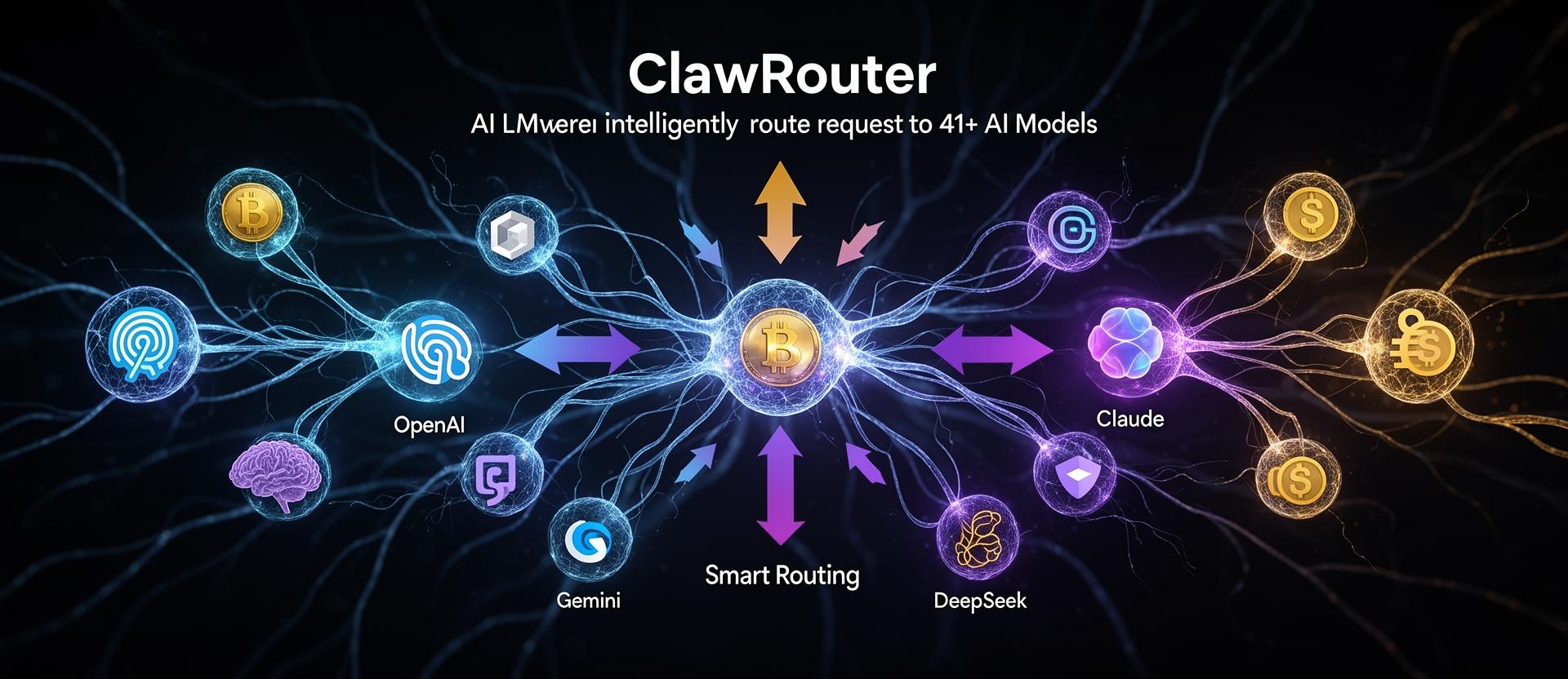
ClawRouter is an agent-native LLM router built for the OpenClaw ecosystem. It sits between your application and 41+ large language models from OpenAI, Anthropic, Google, DeepSeek, xAI, Moonshot, and MiniMax. Using a 15-dimension scoring algorithm that runs locally in under 1 millisecond, it routes every request to the most cost-effective model that can handle the task — saving up to 92% on inference costs compared to using a premium model like Claude Opus for everything.
The project has gained serious traction: 4,300+ GitHub stars, 375 forks, 490+ commits, 22 releases, and 12 contributors as of March 2026. It's a USDC Hackathon Agentic Commerce Winner and supports non-custodial USDC payments on both Base (EVM) and Solana — meaning your wallet signs every transaction and you hold your own keys at all times.
How ClawRouter Works: 15-Dimension Local Routing
The core innovation is the weighted scorer. When a request arrives, ClawRouter evaluates it across 15 dimensions — including task complexity, reasoning depth, context length, code generation requirements, and multilingual needs (supporting 9 languages: EN, ZH, JA, RU, DE, ES, PT, KO, AR). Based on the score, it assigns the request to one of four tiers: SIMPLE, MEDIUM, COMPLEX, or REASONING.
Each tier maps to a specific model depending on the routing profile you've chosen. For example, in AUTO mode (the default), a SIMPLE request goes to kimi-k2.5 at $0.60/$3.00 per million tokens, while a COMPLEX request routes to gemini-3.1-pro at $2/$12. In ECO mode, even complex requests go to gemini-2.5-flash-lite at just $0.10/$0.40 — a 99% cost reduction from Claude Opus pricing.
Crucially, all routing happens locally on your machine. There are zero external API calls for the routing decision itself, which means sub-millisecond latency overhead and complete privacy — your prompts are never sent to a third-party routing service.
Getting Started: Install in 2 Minutes
Installation is a one-liner. Run: curl -fsSL https://blockrun.ai/ClawRouter-update | bash — then restart the gateway with: openclaw gateway restart. That's it. ClawRouter generates a wallet automatically (saved at ~/.openclaw/blockrun/wallet.key) and sets blockrun/auto as your default routing model.
Fund your wallet with as little as $1–5 in USDC on Base or Solana. You can send USDC from Coinbase or any exchange, or from another wallet. The wallet supports both EVM and Solana addresses derived from a single BIP-39 mnemonic. If you don't have USDC, the team accepts credit card payments via their Telegram founder @bc1max.
Once funded, every request is paid per-use via the x402 protocol: your request hits the provider, receives a 402 response with the exact price in the header, your wallet signs the USDC payment, and the request retries with the signed payment — all transparently. There are no accounts, no API keys, and no prepaid balances to manage.
Four Routing Profiles: From Free to Premium
ClawRouter offers four routing profiles you can switch between with the /model command. AUTO (default) provides balanced routing with 74–100% savings — ideal for general-purpose use where you want good quality without overpaying. ECO pushes savings to 95–100% by always routing to the cheapest capable model — perfect for high-volume batch processing, summarization, and classification tasks.
PREMIUM routes to the best-quality model in each tier with 0% savings — use this for mission-critical outputs where accuracy matters more than cost. FREE uses only the free tier (currently nvidia/gpt-oss-120b, a 120B parameter model) for zero-cost inference — great for prototyping, testing, and non-production workloads.
You can also use direct model shortcuts like /model gpt5, /model br-sonnet, /model grok, or /model o3 to target specific models when you need deterministic behavior for a particular task.
The Full Model Lineup: 41+ Models, 7 Providers
ClawRouter supports models from OpenAI (GPT-5.2, GPT-4o, GPT-4o-mini, gpt-oss-120b, o1, o1-mini, o3, o4-mini), Anthropic (Claude Opus 4.6, Sonnet 4.6, Haiku 4.5), Google (Gemini 3.1 Pro, 3 Pro Preview, 3 Flash Preview, 2.5 Pro, 2.5 Flash, 2.5 Flash Lite), DeepSeek (Chat, Reasoner), xAI (Grok 4, Grok 4 Fast, Grok Code Fast), Moonshot (Kimi K2.5), and MiniMax (M2.5).
Pricing ranges from completely free (gpt-oss-120b) to $5/$25 per million tokens (Claude Opus 4.6). The blended average across all tiers in AUTO mode is approximately $2.05 per million tokens — compared to $25/M if you used Claude Opus for everything. That's the 92% savings figure. Even if you use PREMIUM mode for everything, you still benefit from tier-appropriate model selection.
The free tier deserves special mention: gpt-oss-120b serves as an automatic fallback when your wallet is empty. This means your AI agent never completely stops working — it degrades gracefully to a capable 120B model at zero cost.
Image Generation Built In
ClawRouter isn't limited to text. It includes a /imagegen command that routes to 5 image generation models: nano-banana (Google Gemini Flash, $0.05/image), banana-pro (Google Gemini Pro, $0.10/image, up to 4096x4096), dall-e-3 (OpenAI, $0.04/image), gpt-image (OpenAI GPT Image 1, $0.02/image), and flux (Black Forest Flux 1.1, $0.04/image).
Usage is simple: /imagegen a dog dancing on the beach — or specify a model with /imagegen --model dall-e-3 a futuristic city at sunset. Images are returned as hosted URLs compatible with Telegram, Discord, and other chat clients. The default model is nano-banana for fast, cheap generation.
Best Use Case 1: Autonomous AI Agents
ClawRouter was purpose-built for AI agents — software that makes hundreds or thousands of LLM calls autonomously without human intervention. Traditional setups require hardcoding a model choice (expensive if you always use GPT-5) or building custom routing logic (complex and maintenance-heavy). ClawRouter handles this automatically.
An autonomous agent running with ClawRouter in AUTO mode might use the free gpt-oss-120b for simple classification steps, gemini-2.5-flash for medium-complexity data extraction, and grok-4-fast for reasoning-heavy planning — all without any code changes. The agent just sends requests; ClawRouter picks the right model. This is especially powerful for multi-step agentic workflows like research agents, code generation pipelines, and automated customer support systems.
The non-custodial payment model (x402) is also uniquely suited to agents. An agent can autonomously pay for inference from its own wallet without needing API key management, rate limit handling, or account provisioning. Payment IS authentication — the cryptographic wallet signature replaces shared-secret API keys entirely.
Best Use Case 2: Cost-Sensitive Startups and SMBs
If you're a startup burning through AI API credits, ClawRouter can dramatically reduce your bill. Consider a typical SaaS product making 100,000 LLM calls per day. At Claude Opus pricing ($25/M output tokens), assuming 500 output tokens per call, that's $1,250/day or $37,500/month. With ClawRouter in AUTO mode ($2.05/M blended), the same workload costs roughly $102/day or $3,075/month — saving over $34,000 monthly.
For Indian SMBs and startups especially, this cost reduction can be the difference between viable and unviable AI product economics. You get access to the same frontier models (GPT-5.2, Claude Opus 4.6, Gemini 3.1 Pro) without committing to any single provider's pricing. And with the free tier fallback, you can prototype and test without spending anything at all.
Best Use Case 3: Multi-Model Experimentation
Developers and researchers who need to compare model outputs across providers typically maintain separate API keys, billing accounts, and SDK integrations for each provider. ClawRouter collapses this into a single wallet and a single endpoint.
You can switch models on the fly with /model shortcuts, run the same prompt through different tiers to compare quality, or let the AUTO router choose and observe which models it selects for different prompt types. The /stats command shows your usage breakdown and savings over time. For teams evaluating which models to standardize on, this is invaluable — you can make data-driven decisions instead of guessing.
Best Use Case 4: Telegram and Discord Bot Developers
ClawRouter integrates natively with Telegram and Discord bots through the OpenClaw ecosystem. If you're building a conversational bot, you can leverage smart routing to keep costs low for casual conversations (routed to cheap models) while automatically escalating to premium models for complex questions — all transparently to the user.
The image generation support (/imagegen) adds visual capabilities to your bots without separate API integrations. And the streaming SSE format is specifically optimized for Discord compatibility, so responses appear in real-time without duplication issues.
ClawRouter vs OpenRouter: Why It's Different
OpenRouter and LiteLLM are popular alternatives, but ClawRouter takes a fundamentally different architectural approach. OpenRouter requires a human to create an account and manage API keys (shared secrets). ClawRouter lets an agent generate its own wallet — no human setup needed. OpenRouter uses custodial prepaid balances; ClawRouter uses non-custodial per-request payments where you hold your keys.
OpenRouter's routing is proprietary and server-side; ClawRouter's routing is open-source and runs entirely client-side in under 1ms. OpenRouter enforces per-key rate limits; ClawRouter has no rate limits — your wallet, your limits. And the cost difference is stark: OpenRouter charges Opus-equivalent pricing at $25/M, while ClawRouter's blended average is $2.05/M.
The open-source nature is also significant. You can audit the routing algorithm, contribute improvements, fork it for custom routing logic, or run it in air-gapped environments. The MIT license means you can use it commercially without restrictions.
Troubleshooting with AI-Powered Diagnostics
ClawRouter includes a built-in doctor command: npx @blockrun/clawrouter doctor. This collects system diagnostics (OS, Node version, wallet status, network connectivity, proxy status) and sends them to Claude Sonnet for AI-powered analysis — costing about $0.003 per diagnosis. For complex issues, use npx @blockrun/clawrouter doctor opus for deeper analysis at ~$0.01.
You can even ask specific questions: npx @blockrun/clawrouter doctor 'why is my request failing?' — and the doctor supports multilingual queries. This self-diagnosing capability makes ClawRouter remarkably easy to maintain, even for developers who aren't deeply familiar with the x402 protocol or crypto wallet mechanics.
How to Get Started Today
Step 1: Install ClawRouter with curl -fsSL https://blockrun.ai/ClawRouter-update | bash and restart the gateway. Step 2: Fund your wallet with $5 USDC on Base or Solana (address printed on install). Step 3: Start using blockrun/auto as your model in any OpenClaw-compatible client — Telegram, Discord, or any application using the OpenClaw API.
For developers who want to contribute or customize, clone the repo at github.com/BlockRunAI/ClawRouter, run npm install && npm run build && npm test. The project uses TypeScript 5.7, has comprehensive CI (ESLint, Prettier, typecheck, build), and maintains integration tests with Docker.
ClawRouter represents a paradigm shift in how we consume AI models — from static API key management to dynamic, cost-optimized, wallet-authenticated routing. Whether you're building autonomous agents, shipping an AI-powered SaaS product, or just experimenting with multiple models, ClawRouter makes frontier AI accessible at a fraction of the cost. Star the repo, fund your wallet, and start routing smarter.
Build AI Agents & Chatbots for Your Business
Deploy production-grade AI agents powered by cost-optimized LLM routing — customer support, lead qualification, and automation with built-in safety controls.
Explore AI Agent Development →Custom App Development with AI Integration
Build AI-powered web and mobile applications with intelligent model routing, real-time inference, and seamless API integrations — designed for scale and cost efficiency.
Explore App Development →