Anthropic vs OpenAI in 2026: How ClawRouter, PicoClaw, OpenClaw & AI Agents Benefit as Customers
The Two-Front War That Benefits Everyone Else
March 2026 has delivered the sharpest week in the Anthropic-vs-OpenAI rivalry so far. On February 5, Anthropic released Claude Opus 4.6 — a 1M-token context monster with dramatically improved agentic coding, sustained multi-step task execution, and 128K output tokens. Then on March 5, OpenAI fired back with GPT-5.4, its most capable enterprise model yet — native computer-use capabilities, a 1M-token context window, reworked tool-calling, and three variants (GPT-5.4, GPT-5.4 Thinking, and GPT-5.4 Mini) targeting different price/performance points.
Anthropic's annualized revenue has hit $19 billion, closing on OpenAI's $25 billion. Both companies are shipping models every few weeks. The competition is brutal — and that's exactly what downstream AI consumers need. When frontier labs compete this aggressively on capability, price, context length, and safety, every agent framework, LLM router, and embedded AI product benefits.
This post examines both announcements in detail, then analyzes how open-source AI infrastructure — specifically ClawRouter (LLM routing), PicoClaw (edge AI), and OpenClaw (agent orchestration) — turns this rivalry into a strategic advantage for builders and businesses.
Claude Opus 4.6: What Anthropic Shipped
Claude Opus 4.6 arrived on February 5, 2026, as Anthropic's smartest model — and the improvements are not incremental. The headline numbers: it leads Terminal-Bench 2.0 (agentic coding), Humanity's Last Exam, and GDPval-AA benchmarks. But the real story is in how the model works, not just how it scores.
Coding & agentic tasks: Opus 4.6 plans more carefully before writing code, sustains multi-step agentic tasks for significantly longer than its predecessor, and has meaningfully better code review and debugging skills — it catches its own mistakes mid-execution. For AI agent developers, this is transformative. An agent that can self-correct during a 50-step workflow without human intervention reduces failure rates and operational costs dramatically.
1M context window (beta): For the first time in the Opus class, Anthropic offers a million-token context window. This means entire codebases, long legal documents, or multi-hour conversation transcripts can be processed in a single pass. For RAG-based agents, this reduces the complexity of chunking and retrieval pipelines — you can sometimes skip RAG entirely and just stuff the context.
128K output tokens: While most models cap output at 4K-8K tokens, Opus 4.6 can generate up to 128K tokens in a single response. For code generation agents that need to produce entire modules or for report-generation workflows, this eliminates the need for complex multi-turn generation loops.
Safety & cybersecurity: Opus 4.6 includes improved safety features specifically for cybersecurity use cases — detecting and refusing to assist with vulnerability exploitation while remaining helpful for legitimate security research and code auditing. Pricing remains at $5/$25 per million input/output tokens.
GPT-5.4: OpenAI's Enterprise Counter-Punch
OpenAI's GPT-5.4 dropped on March 5, 2026 — literally the day after GPT-5.3 Instant launched — in a clear signal that the company is in full sprint mode. GPT-5.4 comes in three variants targeting different use cases.
GPT-5.4 (flagship): The base model introduces native computer-use capabilities — the ability to operate desktop applications, navigate UIs, click buttons, fill forms, and execute multi-step workflows on a computer. This is OpenAI's direct response to Anthropic's computer-use feature in Claude. The model also includes a 1M-token context window, matching Claude Opus 4.6, and a reworked tool-calling system designed for complex multi-tool agentic workflows.
GPT-5.4 Thinking: A variant with explicit chain-of-thought reasoning — the model shows its reasoning process before producing a final answer. This is crucial for enterprise use cases where auditability and explainability matter (healthcare, finance, legal). It trades speed for accuracy on complex reasoning tasks.
GPT-5.4 Mini: A cost-optimized variant for high-volume, lower-complexity tasks. It retains most of the flagship's capabilities but at significantly reduced inference cost — targeting the same market segment as Claude Sonnet and Gemini Flash.
Financial integrations are a surprise addition: GPT-5.4 includes native plugins for Microsoft Excel and Google Sheets, allowing the model to read, analyze, and manipulate spreadsheet data directly. For enterprise AI agents that process financial data, reports, and forecasts, this eliminates the need for custom data extraction pipelines.
Benchmark performance: GPT-5.4 sets new records on several professional benchmarks, though Anthropic and independent reviewers note that benchmark leadership is increasingly volatile — models trade top spots weekly.
Head-to-Head: Claude Opus 4.6 vs GPT-5.4
Context window: Both now offer 1M tokens — a tie. Output tokens: Claude Opus 4.6 wins with 128K vs GPT-5.4's estimated 32K. This matters for long-form generation and code synthesis. Computer use: Both now support native computer operation, but Anthropic has had this capability longer and it's more battle-tested. GPT-5.4's implementation is newer and still being refined.
Coding & agentic performance: Claude Opus 4.6 leads on Terminal-Bench 2.0 and sustained agentic tasks. GPT-5.4 is competitive but Anthropic's self-correction during multi-step workflows is currently more reliable. Reasoning: GPT-5.4 Thinking provides explicit chain-of-thought, which is valuable for audit trails. Claude's reasoning is embedded but not separately surfaced.
Pricing: Claude Opus 4.6 is $5/$25 (input/output per million tokens). GPT-5.4 pricing varies by variant — the flagship is more expensive than Opus for equivalent tasks, while Mini undercuts on simpler workloads. The pricing structures are complex enough that the 'cheaper' model depends entirely on your specific workload profile.
Enterprise features: GPT-5.4's Excel/Sheets integration gives it an edge for financial and data-analysis workflows. Claude Opus 4.6's safety-first approach and cybersecurity guardrails appeal to regulated industries. Both offer enterprise-grade API access, but OpenAI's ecosystem (ChatGPT Enterprise, Azure OpenAI) is more mature for large organizational deployments.
The honest verdict: Neither model is universally 'better.' The optimal choice depends on your specific task — and for most production systems, the optimal choice changes per-request. That's exactly why LLM routers exist.
ClawRouter: Turning the Rivalry Into a Cost Advantage
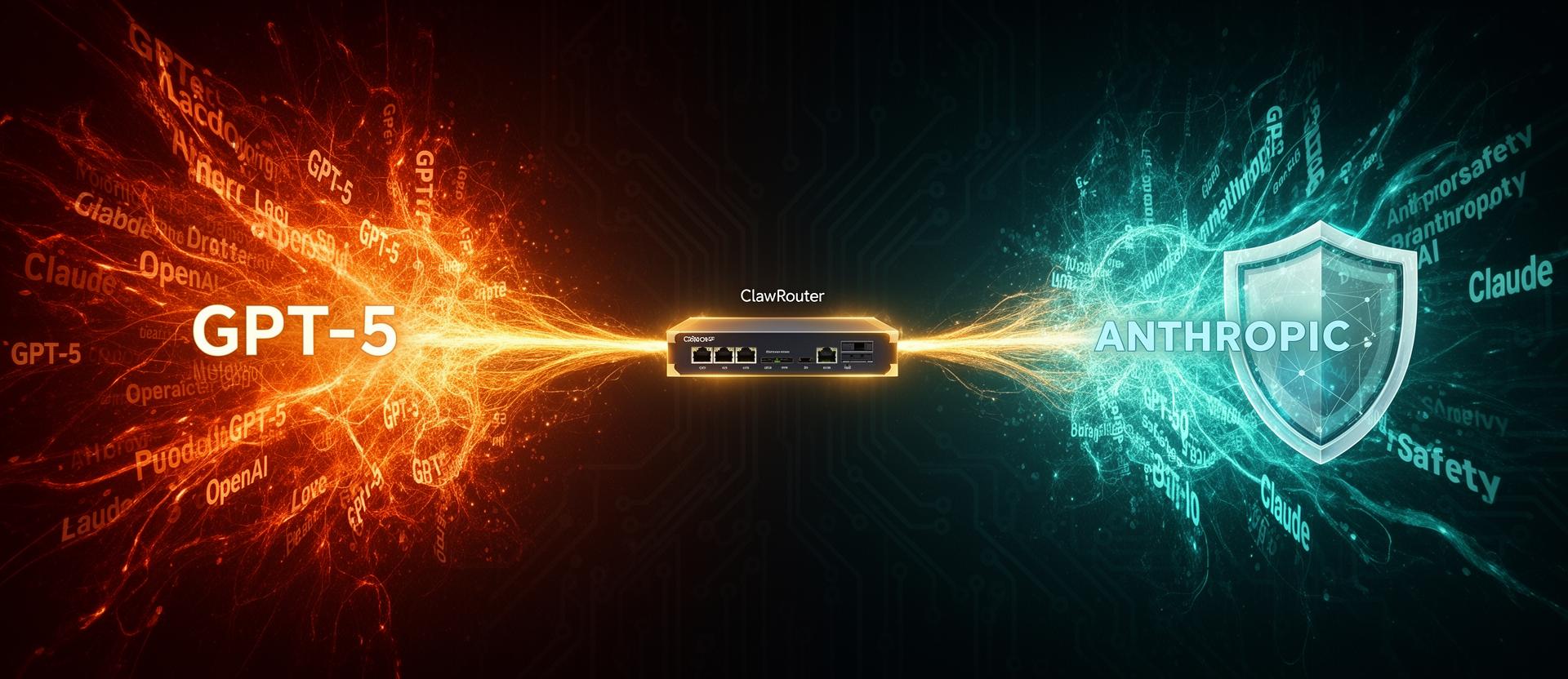
ClawRouter is an open-source LLM router by BlockRunAI that routes every inference request to the optimal model across 41+ providers — including both OpenAI and Anthropic. With the release of GPT-5.4 and Claude Opus 4.6, ClawRouter's value proposition becomes even stronger.
How ClawRouter exploits the rivalry: When two frontier labs ship competing models within weeks of each other, pricing pressure intensifies and capability gaps shift constantly. ClawRouter's 15-dimension local scoring algorithm evaluates each request against factors like task complexity, required context length, expected output length, latency requirements, and cost constraints — then routes to the model that delivers the best quality-per-dollar for that specific request.
GPT-5.4 Mini for simple classification, Claude Opus 4.6 for complex agentic coding, GPT-5.4 Thinking for auditable financial analysis, Claude Sonnet for balanced mid-tier tasks — all from a single API endpoint. The routing happens locally in under 1ms with zero data leaving your infrastructure.
Cost impact with latest models: GPT-5.4's three-tier pricing (flagship, Thinking, Mini) combined with Anthropic's Opus/Sonnet/Haiku tiers creates a 6+ model pricing matrix. ClawRouter navigates this automatically. Early benchmarks show 88-92% cost reduction vs. routing everything to the flagship model, with less than 3% quality degradation on task-appropriate routing.
Non-custodial payments: ClawRouter settles provider payments via USDC on Base and Solana — no credit cards, no intermediaries, no vendor lock-in. As OpenAI and Anthropic adjust pricing in their competitive sprint, ClawRouter users benefit from the lowest available rate automatically.
PicoClaw: Edge AI That Doesn't Pick Sides
PicoClaw is an ultra-lightweight AI assistant written in Go that runs on $10 RISC-V hardware with under 10MB RAM. It boots in 1 second and was 95% AI-generated. But PicoClaw's relevance to the Anthropic-vs-OpenAI rivalry isn't about running frontier models locally — it's about being a smart edge client that decides when and where to call the cloud.
Intelligent request routing at the edge: PicoClaw runs small local models (quantized Phi-4, TinyLlama) for simple tasks — intent classification, template responses, sensor data parsing. When a request exceeds local capability, PicoClaw delegates to the cloud. With ClawRouter as the backend router, PicoClaw's cloud requests automatically go to the best model at the best price — whether that's Claude Opus 4.6 for a complex coding task or GPT-5.4 Mini for a quick summary.
This tiered architecture means PicoClaw users get the benefit of frontier model competition without paying frontier model prices for every request. The edge handles 60-80% of requests locally at near-zero marginal cost. The remaining 20-40% route through ClawRouter to whichever cloud model is optimal that week.
Real-world impact: An IoT monitoring system running PicoClaw on a $10 board handles routine sensor alerts locally. When it detects an anomaly requiring deep analysis, it routes to Claude Opus 4.6 (strongest at complex reasoning over large context). When it needs to generate a brief notification, it routes to GPT-5.4 Mini (cheapest for short outputs). Total cloud spend per device drops below $0.50/month even with frontier model access.
As Anthropic and OpenAI release more model tiers (Haiku, Mini, Nano, Instant), PicoClaw's ability to exploit fine-grained pricing differences becomes more valuable, not less.
OpenClaw: Multi-Model Agent Orchestration
OpenClaw is the agent orchestration layer in the BlockRunAI ecosystem. While ClawRouter handles per-request routing, OpenClaw manages multi-step agent workflows that may span dozens of LLM calls across different models and providers.
How OpenClaw leverages both labs: A typical enterprise agent workflow might involve: (1) Classify incoming request using GPT-5.4 Mini (fast, cheap), (2) Extract structured data from a 500-page PDF using Claude Opus 4.6 (1M context, best at document understanding), (3) Generate a financial analysis with GPT-5.4 Thinking (auditable reasoning), (4) Draft a customer-facing response using Claude Sonnet (balanced quality/cost), (5) Summarize the entire interaction using Gemini Flash (cheapest for summaries).
OpenClaw's workflow engine defines these steps declaratively. Each step specifies the task type, quality requirements, and constraints — OpenClaw + ClawRouter handle model selection automatically. If Anthropic drops Opus pricing tomorrow, or OpenAI ships GPT-5.5 next week, the workflow adapts without code changes.
Fault tolerance across providers: When one provider has an outage (both OpenAI and Anthropic have had multiple incidents in 2026), OpenClaw automatically fails over to the best available alternative. This multi-provider resilience is impossible to achieve when you hard-code a single model provider.
The competitive dynamics matter: As Anthropic and OpenAI each try to win enterprise customers, they both improve reliability, reduce latency, and lower prices. OpenClaw users capture all of these improvements simultaneously, regardless of which lab is 'winning' that month.
The Revenue Race: $25B vs $19B and Why It Matters for Agents
Recent reporting from The Information reveals that OpenAI sits at a $25 billion annualized revenue run rate as of early 2026, while Anthropic has reached $19 billion. The gap is closing — and both companies are investing heavily in enterprise features, model quality, and pricing competitiveness to maintain or grow their market share.
For AI agent builders, this revenue race creates a virtuous cycle: both labs are incentivized to ship faster, price lower, and build better developer tools. Anthropic released anti-ChatGPT commercials mocking OpenAI's plan to introduce ads — a sign that brand competition is intensifying alongside technical competition.
The enterprise push means both labs are building features that agent frameworks need: better tool-calling APIs, longer context windows, more reliable structured output, lower latency inference, and enterprise-grade SLAs. Every improvement to either platform flows through to ClawRouter/OpenClaw users automatically.
Pricing pressure is the most direct benefit. When Anthropic undercuts OpenAI on a model tier, OpenAI responds. When OpenAI ships a Mini variant, Anthropic optimizes Haiku. ClawRouter's routing algorithm captures these price movements in real time — users always get the best available rate without monitoring pricing pages.
Strategic Implications for AI Agent Developers
Do not lock into a single provider. The pace of model releases (OpenAI shipped GPT-5.3 and GPT-5.4 within 48 hours of each other) means today's best model is tomorrow's second-best. Hard-coding model IDs in your agent code is technical debt. Use a routing layer (ClawRouter or similar) that abstracts provider selection.
Exploit model specialization. Claude Opus 4.6 is measurably better at sustained agentic coding. GPT-5.4 Thinking is better at auditable financial reasoning. GPT-5.4 Mini is the cheapest option for high-volume classification. A well-designed agent workflow uses all of these — not just one.
Plan for edge + cloud hybrid. PicoClaw demonstrates that 60-80% of AI requests don't need frontier models. Build your agent architecture with a local-first approach that escalates to cloud only when necessary. This dramatically reduces costs and improves latency.
Watch the safety and compliance angle. Anthropic's safety-first positioning and Claude's cybersecurity guardrails matter for regulated industries. OpenAI's enterprise features (Azure integration, SOC 2 compliance, data residency) matter for large organizations. Your agent framework should be able to route to the compliant provider per-request, not per-project.
Build for multi-model by default. The era of 'one model to rule them all' is over. The winning strategy is multi-model orchestration — and the tools (ClawRouter, OpenClaw, PicoClaw) exist today to make this practical without building everything from scratch.
How Indian Businesses Should Respond
Indian AI startups and enterprises are uniquely positioned to benefit from the Anthropic-OpenAI competition. India is one of the fastest-growing AI markets, with both labs actively courting Indian enterprise customers and developers.
Cost sensitivity makes routing essential: Indian businesses typically operate at lower margins than US/EU counterparts. The difference between routing all requests to Claude Opus 4.6 ($25/M output tokens) vs. intelligently routing to GPT-5.4 Mini for simple tasks ($2-3/M output tokens) can mean the difference between a profitable AI feature and one that burns cash. ClawRouter makes this automatic.
Multilingual advantage: Both Claude Opus 4.6 and GPT-5.4 have improved Hindi, Tamil, Telugu, Bengali, and other Indian language support. For customer-facing AI agents serving Indian users, testing both providers per-language and routing to the stronger model for each language improves response quality without increasing costs.
Edge deployment for Tier-2/3 markets: PicoClaw's ability to run on $10 hardware is relevant for Indian businesses deploying AI in areas with unreliable connectivity. Local inference for routine tasks, cloud escalation only when needed, and automatic routing through ClawRouter when cloud is available — this architecture works even on 2G/3G connections.
Regulatory preparedness: India's upcoming AI regulatory framework will likely require transparency about which AI models are used in consumer-facing applications. Multi-model architectures with clear routing logs (which ClawRouter provides) make compliance straightforward — you can demonstrate exactly which model processed each request and why.
What to Expect Next: GPT-5.5, Claude 5, and the Agent Infrastructure Layer
Both labs are on an accelerating release cadence. OpenAI shipped three model variants in a single week (GPT-5.3 Instant, GPT-5.4, GPT-5.4 Thinking). Anthropic is reportedly working on Claude 5, which insiders describe as a 'significant architecture change' rather than an incremental improvement. Google's Gemini 3 Pro is also in preview, adding a third frontier competitor.
The trend is clear: more models, more variants, more pricing tiers, more specialized capabilities. This increasing complexity is exactly what makes routing and orchestration layers indispensable. Manually choosing and managing models across 3+ providers with 5+ variants each is not sustainable for any engineering team.
Agent infrastructure is becoming the critical layer. Just as Kubernetes abstracted away server management, tools like ClawRouter, OpenClaw, and PicoClaw are abstracting away model management. The companies that build on this abstraction layer will be more resilient, more cost-efficient, and faster to adopt new capabilities as frontier labs ship them.
The bottom line: Anthropic and OpenAI are building increasingly powerful, increasingly commoditized AI capabilities. The strategic value is shifting from 'which model you use' to 'how intelligently you use all of them.' Invest in the orchestration layer, not in provider loyalty. The rivalry between these labs is your advantage — but only if your architecture is designed to exploit it.
Build AI Agents with Multi-Model Orchestration
Deploy production-grade AI agents powered by intelligent LLM routing — use the best model for each task automatically, with built-in failover across OpenAI, Anthropic, and Google.
Explore AI Agent Development →See How ClawRouter Cuts AI Costs by 92%
Deep dive into ClawRouter's 15-dimension scoring, 41+ model routing, non-custodial USDC payments, and real-world cost optimization for AI agents and startups.
Read the ClawRouter Deep Dive →