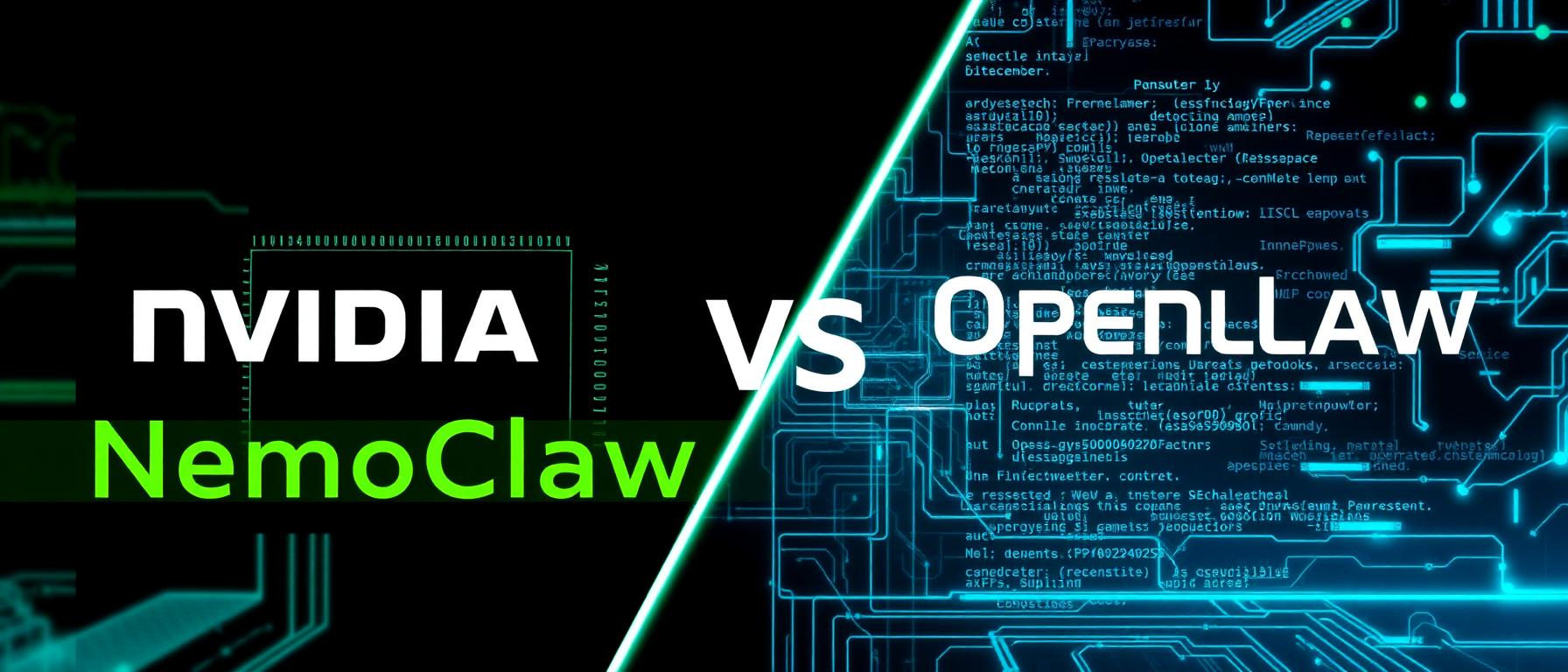
Nvidia NemoClaw vs OpenClaw — Which AI Agent Framework Should You Use in 2026? Use Cases & the SaaS to AgaS Shift
The Rise of AI Agent Frameworks in 2026
The AI landscape in 2026 is no longer about chatbots answering FAQs. We have entered the era of autonomous AI agents — software entities that perceive their environment, make decisions, execute multi-step tasks, and learn from outcomes without constant human supervision. From customer support pipelines to financial reconciliation, from DevOps incident response to marketing campaign orchestration, AI agents are rapidly replacing static SaaS workflows across industries.
Two frameworks have emerged at the center of this revolution: Nvidia's NemoClaw and the community-driven OpenClaw. Each takes a fundamentally different approach to building, deploying, and scaling AI agents. This comprehensive guide breaks down architecture, performance, use cases, and cost — and explains the broader shift from SaaS to AgaS (Agent as a Service), a term popularized by Nvidia CEO Jensen Huang at GTC 2026.
Whether you are a startup exploring AI automation, an enterprise modernizing legacy systems, or a developer choosing your next stack — this comparison will help you make the right call.
What Is Nvidia NemoClaw?
NemoClaw is Nvidia's enterprise-grade AI agent framework, built on top of the Nemo platform and tightly integrated with Nvidia's GPU ecosystem. It is designed for organizations that need maximum inference performance, enterprise security, and seamless integration with Nvidia's hardware and software stack.
Key features of NemoClaw include: GPU-optimized agent runtime with CUDA-accelerated inference pipelines that deliver 3-5x faster execution compared to CPU-based frameworks; native NIM (Nvidia Inference Microservices) integration for deploying fine-tuned models as containerized microservices; Omniverse-ready agent simulation for testing agents in photorealistic 3D environments before production deployment; enterprise guardrails with built-in content filtering, hallucination detection, and compliance logging; and multi-agent orchestration with hierarchical task delegation across specialized sub-agents.
NemoClaw supports leading foundation models including Llama 3.1, Nemotron, Mistral, and custom fine-tuned models deployed through NIM containers. It provides a declarative YAML-based agent definition language and a visual Agent Studio for non-technical users to design agent workflows.
What Is OpenClaw?
OpenClaw is an open-source, community-driven AI agent framework designed for flexibility, cost efficiency, and model-agnostic deployment. Originally incubated by the BlockRunAI community (the same team behind ClawRouter), OpenClaw has grown into a production-ready framework used by thousands of developers worldwide.
Core strengths of OpenClaw include: model-agnostic architecture that works with any LLM provider — OpenAI, Anthropic, Google, Mistral, open-source models, or self-hosted; lightweight runtime with sub-100ms agent initialization and minimal memory footprint; plugin ecosystem with 200+ community-built tools for CRM integration, database queries, API orchestration, and file processing; flexible deployment across cloud (AWS, GCP, Azure), edge devices, and on-premise infrastructure; and transparent pricing with no vendor lock-in — you pay only for the LLM inference costs.
OpenClaw uses a Python-first SDK with TypeScript bindings, making it accessible to the broadest developer audience. Its agent definition is code-first, giving developers full control over execution flow, error handling, and state management.
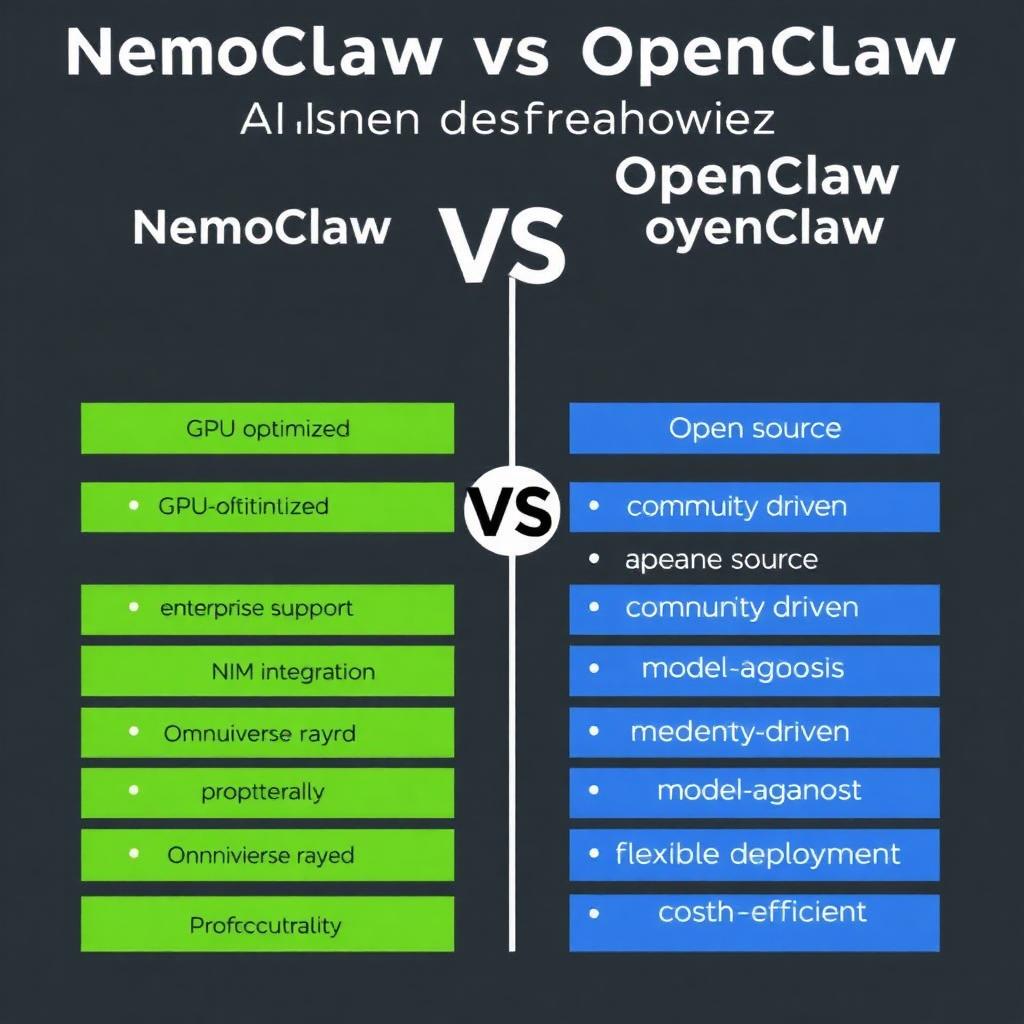
NemoClaw vs OpenClaw: Head-to-Head Comparison
Performance: NemoClaw delivers superior raw inference speed on Nvidia GPUs (A100, H100, B200) due to deep CUDA optimization. On identical hardware, NemoClaw agents complete complex multi-step tasks 40-60% faster than OpenClaw. However, OpenClaw's lightweight runtime means faster cold starts and lower memory usage — critical for serverless and edge deployments where GPU access may be limited.
Cost: NemoClaw requires Nvidia Enterprise licensing (starting at $4,500/GPU/year for NIM) plus GPU infrastructure costs. OpenClaw is free and open-source — total cost is limited to LLM API calls and hosting. For a team running 10 agents processing 50,000 tasks/month, estimated costs are: NemoClaw at $8,000-15,000/month (infrastructure + licensing) versus OpenClaw at $1,500-4,000/month (LLM API + hosting only).
Ecosystem and integration: NemoClaw integrates natively with Nvidia's ecosystem — DGX Cloud, Omniverse, RAPIDS, and Triton Inference Server. This is powerful for enterprises already invested in Nvidia infrastructure. OpenClaw integrates with everything else — any cloud provider, any LLM, any database, and has a thriving plugin marketplace with community contributions.
Enterprise readiness: NemoClaw provides SOC 2 compliance, role-based access control, audit logging, and dedicated Nvidia support. OpenClaw offers community support with optional paid enterprise support from several third-party providers, but lacks built-in compliance tooling.
Learning curve: NemoClaw's visual Agent Studio lowers the barrier for business users, but full customization requires familiarity with Nvidia's toolchain. OpenClaw's code-first approach appeals to developers but requires more technical expertise to get started.
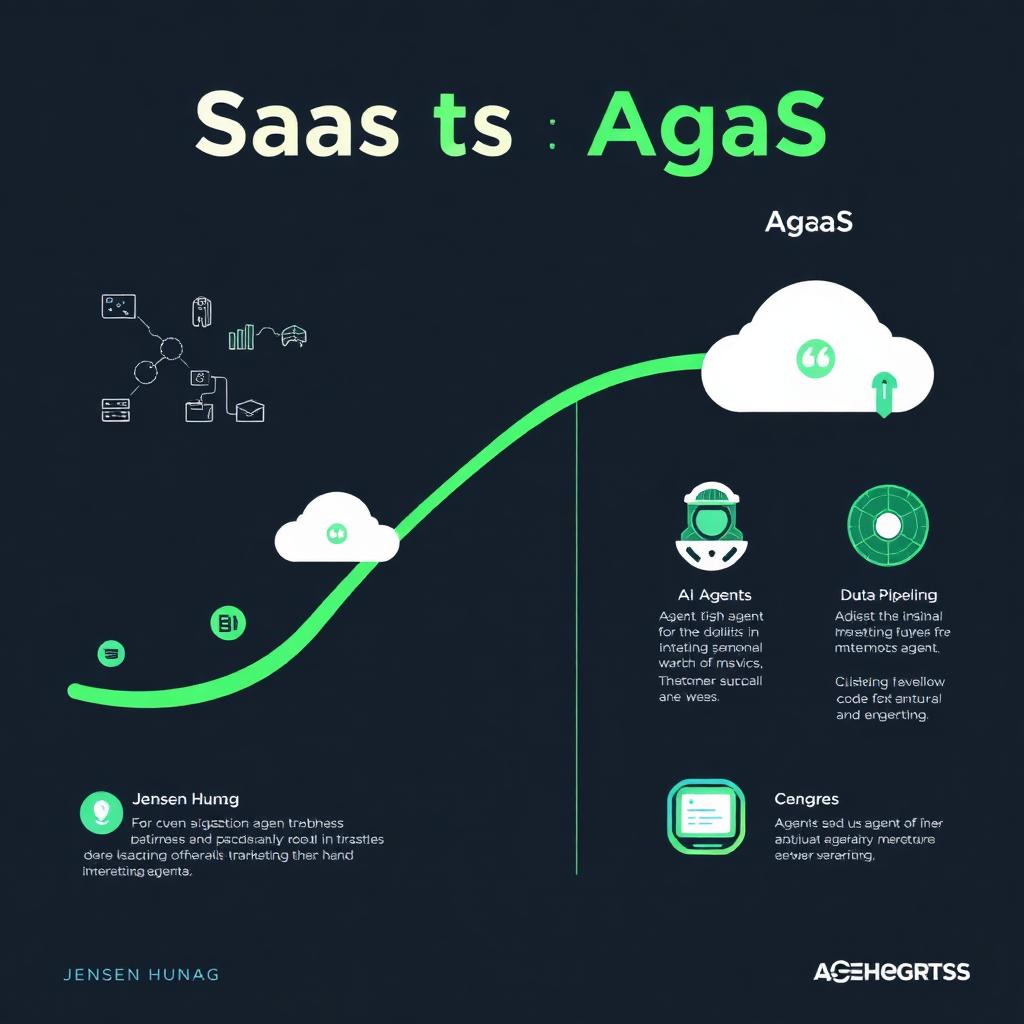
The SaaS to AgaS Shift: Jensen Huang's Vision
At GTC 2026, Nvidia CEO Jensen Huang introduced the term 'AgaS' — Agent as a Service — to describe the next evolution of cloud computing. His thesis is straightforward: in the SaaS era, businesses subscribed to software tools that required human operators. In the AgaS era, businesses will subscribe to AI agents that autonomously perform the work those tools were designed to support.
Consider the difference: a SaaS CRM requires a sales rep to log calls, update deal stages, and generate reports. An AgaS CRM deploys an AI agent that listens to calls, updates records automatically, identifies at-risk deals, drafts follow-up emails, and generates forecasts — all without human intervention. The software becomes the worker, not just the tool.
Jensen Huang specifically highlighted three categories of AgaS transformation: IT AgaS — AI agents that monitor infrastructure, resolve incidents, apply patches, and optimize cloud costs autonomously (replacing tools like PagerDuty + Terraform + CloudWatch with a single agent); Marketing AgaS — agents that plan campaigns, generate creative assets, manage ad spend across channels, A/B test messaging, and optimize in real-time; and Customer Service AgaS — agents that handle L1-L3 support tickets, escalate edge cases to humans, and continuously improve from resolved cases.
This is not a distant future. Companies like ServiceNow, Salesforce, and HubSpot are already embedding agent capabilities into their platforms. The difference is whether you build on a proprietary stack (NemoClaw) or an open one (OpenClaw). Digital Koncept, as an AgaS company based in Delhi-NCR, helps businesses navigate this transition by designing, deploying, and managing production-grade AI agents using the right framework for each use case.
Use Cases: When to Choose NemoClaw
Choose NemoClaw when your organization has heavy GPU infrastructure investment (DGX clusters, A100/H100/B200 fleets), needs maximum inference throughput for latency-sensitive applications (real-time trading, autonomous vehicle simulation, live video analysis), requires Omniverse integration for 3D agent simulation and digital twin workflows, demands enterprise compliance with SOC 2, HIPAA, or financial regulatory requirements out of the box, or is building multi-modal agents that process video, 3D, and sensor data alongside text.
Specific NemoClaw use cases include: autonomous factory floor monitoring with agents processing camera feeds, sensor data, and production logs to predict maintenance needs and optimize throughput; financial trading agents that analyze market data, execute trades, and manage risk in sub-millisecond timeframes on GPU-accelerated infrastructure; and healthcare diagnostic agents that process medical imaging (X-ray, MRI, CT) alongside patient records for clinical decision support.
Use Cases: When to Choose OpenClaw
Choose OpenClaw when you need model flexibility — switching between OpenAI, Anthropic, Google, and open-source models based on task requirements and cost; your deployment targets include serverless environments (AWS Lambda, Cloudflare Workers) or edge devices where GPU access is limited; budget constraints require minimizing fixed costs — OpenClaw's pay-per-use model with no licensing fees; your team prefers code-first development with full control over agent behavior and state; or you are building agents for text-heavy workflows (customer support, content generation, data processing) where GPU acceleration provides marginal benefit.
Specific OpenClaw use cases include: e-commerce customer support agents deployed on WhatsApp and Telegram that handle order tracking, returns, and product recommendations using GPT-4o for complex queries and GPT-4o-mini for routine tasks via ClawRouter; content marketing agents that research topics, draft blog posts, generate social media content, and schedule publishing across platforms; and data pipeline agents that extract information from invoices, contracts, and emails, transform it into structured data, and load it into CRM or ERP systems.
Digital Koncept: Your AgaS Partner in Delhi-NCR
Digital Koncept is an AgaS company — we do not just build chatbots, we design autonomous AI agent systems that replace manual workflows across your business. Based in Delhi-NCR, our team has deployed 50+ production AI agents for clients across healthcare, e-commerce, real estate, education, and financial services.
Our AI agent development services include: framework selection consulting — we assess your infrastructure, use cases, budget, and compliance needs to recommend NemoClaw, OpenClaw, or a hybrid approach; agent design and architecture — multi-agent systems with specialized sub-agents for different tasks, intelligent routing, and human-in-the-loop escalation; LLM integration and optimization — model selection, fine-tuning, prompt engineering, and cost optimization using ClawRouter for multi-model routing; deployment and monitoring — production deployment on your cloud, edge, or hybrid infrastructure with real-time performance monitoring and alerting; and ongoing optimization — continuous improvement based on agent performance data, user feedback, and evolving business requirements.
Whether you are automating customer support on WhatsApp, building a data processing pipeline, or deploying an AI-powered sales assistant — Digital Koncept delivers the AgaS solution that fits your business. Our expertise spans both NemoClaw and OpenClaw ecosystems, ensuring you get the right tool for the job without vendor lock-in.
The Verdict: NemoClaw or OpenClaw?
There is no universal answer — the right choice depends on your specific context. If you are an enterprise with existing Nvidia infrastructure, need maximum GPU performance, and require built-in compliance — NemoClaw is the clear choice. If you are a startup, mid-size business, or developer team that values flexibility, cost efficiency, and model freedom — OpenClaw gives you everything you need without lock-in.
The most sophisticated teams use both: NemoClaw for GPU-intensive, latency-critical workloads and OpenClaw for the long tail of text-heavy, cost-sensitive agent tasks. This hybrid approach, combined with intelligent routing through ClawRouter, delivers the best performance-per-dollar across your entire agent fleet.
The SaaS-to-AgaS shift is not coming — it is here. The question is not whether to adopt AI agents, but which framework powers them. Make the right choice, and your business gains an autonomous workforce that scales without headcount. Make the wrong choice, and you are locked into a stack that does not fit your needs.
Digital Koncept is here to help you get it right. As a dedicated AgaS company in Delhi-NCR, we bring deep expertise in both NemoClaw and OpenClaw — plus the full-stack digital capabilities (web development, WhatsApp marketing, SEO, data digitization) to integrate agents across your entire business. Contact us to discuss your AI agent strategy.
Build Production-Grade AI Agents with Digital Koncept
We design, deploy, and manage autonomous AI agents using NemoClaw, OpenClaw, or hybrid architectures — from framework selection to production monitoring, optimized for your use case and budget.
Explore AI Agent Development →See How ClawRouter Cuts AI Agent Costs by 92%
Intelligent multi-model routing across OpenAI, Anthropic, Google, and open-source models — the backbone of cost-efficient OpenClaw agent deployments.
Read the ClawRouter Deep Dive →