Top 10 WhatsApp Business API Features Every Delhi-NCR Business Should Use in 2026
Why WhatsApp Business API Is Non-Negotiable for Delhi-NCR Businesses in 2026
India has over 500 million WhatsApp users, and Delhi-NCR alone accounts for one of the highest concentrations of active users in the country. For businesses operating in this market — from Connaught Place retailers to Gurgaon SaaS startups to Noida e-commerce operations — WhatsApp isn't just a messaging app. It's the primary communication channel your customers already live on.
The WhatsApp Business API (distinct from the free WhatsApp Business App) unlocks enterprise-grade features that transform WhatsApp from a simple chat tool into a full-fledged marketing, sales, and support platform. While the free app works for micro-businesses, any Delhi-NCR operation handling more than 50–100 customer conversations per day needs the API to scale effectively.
In 2026, the API has matured significantly — with features like WhatsApp Flows, Channels, Meta Verified badges, and AI-powered chatbot integrations that didn't exist even 18 months ago. This guide covers the 10 most impactful features and exactly how Delhi-NCR businesses across industries are using them to drive revenue, reduce costs, and build customer loyalty.
1. Broadcast Messaging with Template Messages
Template messages are pre-approved message formats that let you initiate conversations with customers at scale — promotional offers, order updates, appointment reminders, payment confirmations, and more. Unlike the free app's broadcast limit of 256 contacts, the API lets you send to unlimited contacts with proper opt-in.
For Delhi-NCR businesses, this is the single most revenue-driving feature. A restaurant chain in South Delhi can blast a Diwali special menu to 50,000 opted-in customers. A Gurgaon fitness center can send class schedule updates to all members every Monday morning. A Noida real estate developer can share new project launches with their entire prospect database.
Key considerations: All templates must be approved by Meta before use (typically 24–48 hours). Templates are categorized as utility (order updates, OTPs), authentication (login codes), or marketing (promotions, offers). Marketing templates cost more per message than utility templates. Always maintain proper opt-in records — TRAI regulations and Meta's commerce policy both require explicit consent.
Pro tip for Delhi-NCR: Use Hindi + English bilingual templates. Our data shows that bilingual templates get 23% higher engagement in Delhi-NCR compared to English-only messages.
2. Interactive Messages: Buttons, Lists & Quick Replies
Static text messages get read. Interactive messages get action. The API supports three types of interactive elements: Quick Reply Buttons (up to 3 buttons for fast responses like 'Yes / No / Maybe Later'), Call-to-Action Buttons (direct links to your website or phone dialer), and List Messages (up to 10 options in a scrollable menu, perfect for product catalogs or service menus).
A Gurgaon car dealership uses list messages to let prospects browse available models, select a variant, and book a test drive — all within WhatsApp. A Delhi diagnostic lab uses quick reply buttons for appointment confirmation: 'Confirm / Reschedule / Cancel.' A Noida food delivery startup uses CTA buttons linking directly to their order page.
Interactive messages see 35–45% higher response rates compared to plain text. In Delhi-NCR's fast-paced market where customers are bombarded with messages, interactivity is what separates your message from being ignored versus acted upon.
3. WhatsApp Flows: In-App Forms & Transactions
WhatsApp Flows is one of the most powerful features launched in recent years. It lets you build multi-step forms, surveys, appointment bookings, and even checkout experiences entirely within WhatsApp — without redirecting users to an external website or app.
For Delhi-NCR businesses, this eliminates the biggest conversion killer: app switching. A Dwarka dental clinic can collect patient details, preferred appointment slots, and insurance information through a WhatsApp Flow — no website visit required. A Greater Noida real estate firm can run a lead qualification flow asking budget, preferred location, and property type, then auto-assign the lead to the right sales agent.
Flows support text inputs, dropdowns, date pickers, radio buttons, and checkboxes. They can be triggered from template messages, chatbot conversations, or QR code scans. The data collected flows directly into your CRM or backend system via webhooks.
This feature is particularly valuable in Delhi-NCR where a significant portion of your audience may have limited data plans or older smartphones — keeping them inside WhatsApp (which is already optimized for low bandwidth) dramatically improves completion rates versus sending them to a separate website.
4. Catalog & Cart: Native Commerce Experience
The WhatsApp Business API now supports product catalogs with up to 500 items, complete with images, descriptions, pricing, and direct 'Add to Cart' functionality. Customers can browse your catalog, add items, and send the cart as an order — all without leaving WhatsApp.
For Delhi-NCR retailers, this is a game-changer. A Lajpat Nagar boutique can showcase their entire collection via WhatsApp catalog. A Karol Bagh electronics shop can share product specs and prices instantly when a customer inquires. A Gurgaon bakery can let customers build custom cake orders with flavor, size, and decoration options.
Catalogs can be shared in conversations, embedded in template messages, and accessed via your WhatsApp business profile. They sync with your product inventory via the API, so pricing and availability stay current. Combined with WhatsApp Payments (available in India), this creates a complete commerce loop: browse → add to cart → pay → receive confirmation — entirely inside WhatsApp.
5. AI-Powered Chatbots & Automated Conversations
The API's webhook architecture lets you connect any AI/NLP engine to power intelligent, context-aware chatbots. In 2026, this isn't about simple keyword-matching bots — modern WhatsApp chatbots understand natural language, maintain conversation context, handle multiple languages (critical for Delhi-NCR's Hindi-English mix), and escalate to human agents when needed.
A Delhi hospital uses an AI chatbot to handle appointment booking, report delivery, doctor availability queries, and basic symptom triage — handling 80% of incoming WhatsApp messages without human intervention. A Noida EdTech company uses a chatbot to qualify leads, answer course queries, share demo videos, and schedule counselor callbacks. A Gurgaon logistics firm uses a bot for real-time shipment tracking — customers type their AWB number and get instant status updates.
The ROI is dramatic: businesses deploying WhatsApp chatbots typically see 60–70% reduction in support ticket volume and 3–5x faster response times. For Delhi-NCR businesses operating across multiple time zones (serving customers nationally or internationally), a 24/7 chatbot ensures no lead or query goes unanswered.
Integration options include Dialogflow, Rasa, custom LLM-based agents (GPT, Gemini), and no-code platforms like Yellow.ai and Gupshup. Choose based on your complexity needs and budget.
6. WhatsApp Channels: One-to-Many Broadcasting
WhatsApp Channels (introduced in 2023, now fully mature) are one-way broadcast feeds — similar to Telegram Channels — where businesses can share updates, news, offers, and content to followers. Unlike template messages, Channels don't have per-message costs, making them ideal for high-frequency content distribution.
For Delhi-NCR businesses, Channels serve as a free, high-engagement content distribution platform. A South Delhi fashion brand posts daily outfit inspiration. A Gurgaon stock advisory firm shares market tips every morning. A Delhi restaurant group announces daily specials across their outlets. A Noida coaching institute shares study material and exam tips.
Channels appear in a dedicated tab in WhatsApp, and users can follow/unfollow freely. Content is visible for 30 days. While Channels don't support two-way conversation, they're excellent for brand awareness, customer retention, and driving traffic to your website or WhatsApp chat for actual transactions.
Pro tip: Cross-promote your WhatsApp Channel on your Google Business Profile, Instagram bio, website header, and email signatures. Delhi-NCR businesses that actively promote their Channel typically reach 5,000+ followers within 3–6 months.
7. Multi-Agent Support with Team Inbox
The API enables multiple team members to handle conversations simultaneously through a shared team inbox — provided via your Business Solution Provider (BSP) or CRM integration. This is essential for any Delhi-NCR business handling more than 20–30 conversations per day.
Features include: conversation assignment and routing (auto-assign based on department, language, or round-robin), agent performance analytics (response time, resolution time, customer satisfaction), internal notes and tags (agents can leave context for colleagues), canned responses (pre-built replies for common queries), and SLA tracking (ensure no conversation exceeds your response time target).
A Delhi multi-brand auto dealership routes inquiries to the right brand specialist automatically. A Gurgaon property management company assigns tenant queries to the relevant property manager. A Noida healthcare network routes patients to the nearest clinic's support team based on their pin code.
Without multi-agent support, you're limited to one person managing all conversations — which creates bottlenecks, missed messages, and frustrated customers. In Delhi-NCR's competitive service landscape, response speed is a direct differentiator.
8. Click-to-WhatsApp Ads (CTWA) Integration
Click-to-WhatsApp Ads let you run Facebook and Instagram ads that open a WhatsApp conversation directly when clicked — bypassing landing pages entirely. The API integration enables automated welcome messages, chatbot qualification flows, and instant lead capture the moment someone clicks your ad.
For Delhi-NCR businesses spending on Meta Ads, CTWA typically delivers 2–4x higher conversion rates compared to traditional landing page ads. Why? Because there's zero friction — no form filling, no page loading, no app downloading. The customer is already on WhatsApp, and they're talking to you within seconds.
A Gurgaon interior design firm runs Instagram ads showcasing their projects. When prospects click, they land in a WhatsApp chatbot that asks their budget, property size, and timeline — qualifying the lead in 60 seconds. A Delhi wedding planner runs Facebook ads targeting engaged couples in NCR. One click opens a WhatsApp conversation with their portfolio, packages, and a booking flow.
CTWA ads work exceptionally well in Delhi-NCR because WhatsApp is the default communication preference. Asking someone to fill a web form feels like friction; asking them to send a WhatsApp message feels natural.
9. Meta Verified Badge & Green Tick
The Meta Verified badge (green tick) on your WhatsApp Business profile signals authenticity and builds instant trust. In Delhi-NCR, where customers are increasingly wary of spam and fraud, the green tick is a powerful credibility signal — especially for new customer acquisition.
To qualify, your business needs a verified Facebook Business Manager, an active WhatsApp Business API account with a clean sending reputation, and compliance with Meta's commerce and messaging policies. The verification process typically takes 2–4 weeks.
Verified businesses see higher message open rates (customers trust messages from verified senders), better deliverability (Meta's spam filters are less aggressive with verified accounts), and increased brand credibility on WhatsApp profile views. For Delhi-NCR businesses in trust-sensitive categories — healthcare, finance, education, real estate — the green tick can meaningfully impact conversion rates.
Important: The green tick is available only through the API, not the free WhatsApp Business App. This alone is reason enough for serious Delhi-NCR businesses to upgrade to the API.
10. Analytics, Webhooks & CRM Integration
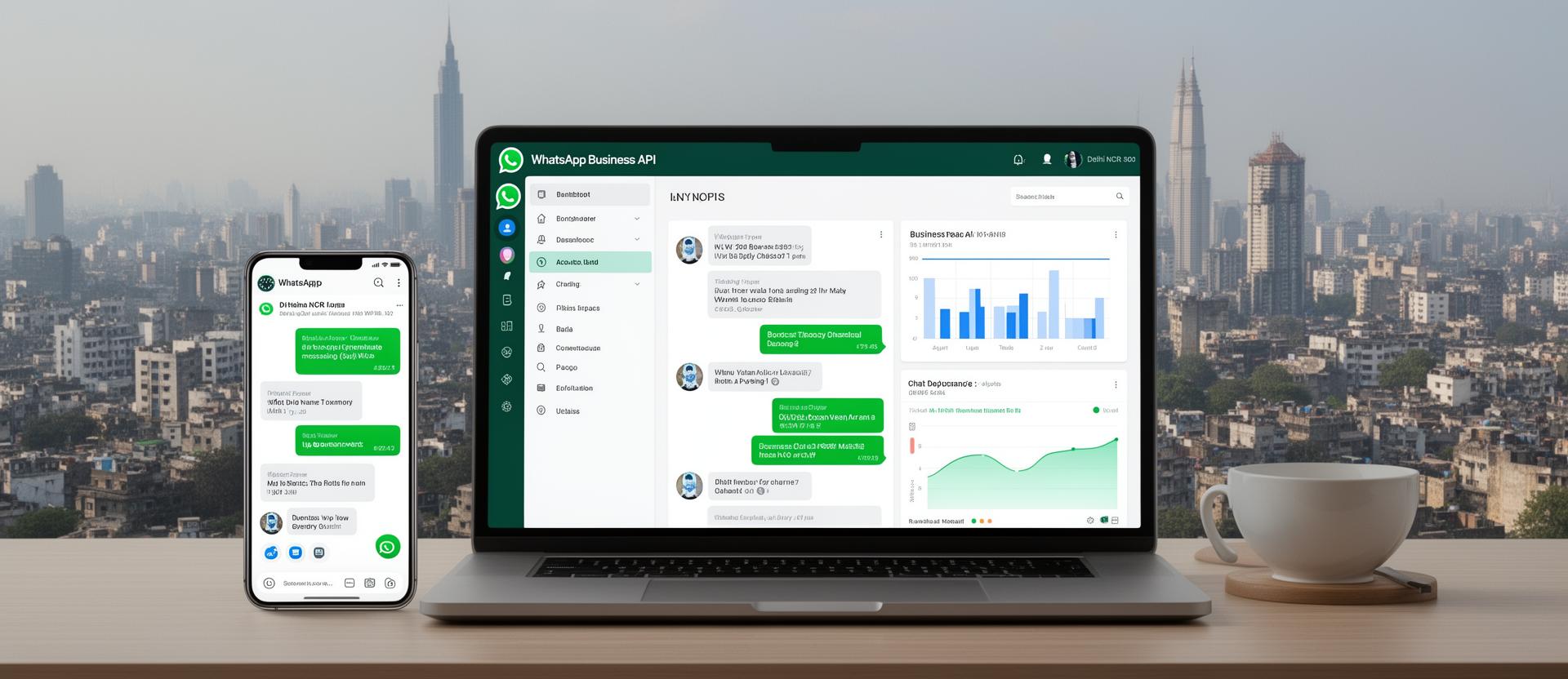
The API provides granular analytics on message delivery, read rates, response times, and conversation outcomes. Combined with webhook integrations, every WhatsApp interaction can flow into your CRM (HubSpot, Zoho, Salesforce, LeadSquared), analytics platform, or custom dashboard.
This data-driven approach is what separates professional WhatsApp marketing from spray-and-pray broadcasting. You can track: which template messages drive the most conversions, what time of day your Delhi-NCR audience is most responsive (typically 10–11 AM and 7–9 PM), which products/services get the most catalog views, chatbot drop-off points that need optimization, and agent performance benchmarks.
A Noida D2C brand tracks WhatsApp-attributed revenue by connecting their API to Shopify — they know exactly how much revenue each broadcast campaign generates. A Delhi healthcare chain feeds WhatsApp appointment data into their EHR system, creating a unified patient journey. A Gurgaon financial advisory firm logs every WhatsApp interaction in LeadSquared, scoring leads based on engagement.
Without analytics integration, you're flying blind. The API's data capabilities let you optimize continuously — testing message timing, template variations, chatbot flows, and team performance to maximize ROI from every conversation.
Getting Started: What You Need
To start using the WhatsApp Business API in Delhi-NCR, you need: a Facebook Business Manager account (verified), a dedicated phone number (not currently registered on WhatsApp), a Business Solution Provider (BSP) like Gupshup, Twilio, Wati, or Interakt, and Meta Business verification (GSTIN, website, and business documents).
Setup typically takes 3–7 days. Costs include: per-conversation charges (utility: ~₹0.35, marketing: ~₹0.75, service: free for 24 hours after customer-initiated contact), BSP platform fees (₹2,000–₹15,000/month depending on features), and optional chatbot development costs.
For most Delhi-NCR SMBs, the total investment is ₹5,000–₹20,000/month — which pays for itself with the first few conversions. Enterprise operations with high volumes can negotiate custom pricing with BSPs.
The biggest mistake Delhi-NCR businesses make is waiting too long to migrate from the free app to the API. Every month you delay, you're leaving revenue on the table, missing leads due to slow response times, and losing customers to competitors who are already running automated, professional WhatsApp operations.
Final Takeaway
WhatsApp Business API isn't a 'nice to have' for Delhi-NCR businesses in 2026 — it's infrastructure. Just as you wouldn't operate without a website or a phone line, you shouldn't operate without a professional WhatsApp presence.
Start with the features that solve your biggest pain point: if you're drowning in support queries, deploy a chatbot. If you need more leads, run CTWA ads. If your broadcasts aren't converting, upgrade to interactive templates with buttons and flows. If you're losing track of conversations, implement a team inbox.
The businesses that will dominate their Delhi-NCR markets in 2026 are the ones treating WhatsApp not as a chat app, but as a full-stack customer engagement platform — with the API features to match.
Launch Your WhatsApp & RCS Marketing Campaigns
End-to-end WhatsApp Business API setup, chatbot development, broadcast campaigns, CTWA ad management, and RCS marketing — all handled by our expert team in Delhi-NCR.
Explore WhatsApp Marketing Services →