Voice Broadcasting vs WhatsApp Marketing: Which Channel Delivers Better ROI for Delhi-NCR Businesses?
The Channel Dilemma: Voice or WhatsApp?
Delhi-NCR businesses face a critical marketing question in 2026: should you invest in voice broadcasting (OBD calls, IVR campaigns, automated calling) or WhatsApp marketing (API broadcasts, chatbots, interactive campaigns)? Both channels reach customers directly on their phones, both cut through the noise of crowded email inboxes and social media feeds, and both deliver measurable results.
But they work very differently — in cost structure, engagement mechanics, compliance requirements, and audience reception. Choosing the wrong channel (or the wrong balance between them) means wasted budget, lower conversions, and missed opportunities.
This comparison breaks down both channels across 10 critical dimensions — with real data and Delhi-NCR-specific insights — so you can make an informed decision for your business. Spoiler: the answer isn't always one or the other.
Cost Per Reach: Voice Broadcasting Wins on Volume
Voice broadcasting (Outbound Dialing / OBD) costs between ₹0.15–₹0.40 per connected call in India, depending on your provider, volume, and whether you're calling mobile or landline. A 30-second pre-recorded message to 100,000 numbers costs roughly ₹15,000–₹40,000.
WhatsApp Business API marketing messages cost approximately ₹0.70–₹0.85 per conversation (Meta's pricing for marketing-category templates in India). The same 100,000 messages would cost ₹70,000–₹85,000 — roughly 2–3x more than voice.
However, raw cost-per-reach is misleading. What matters is cost-per-action. A voice call that goes unanswered or gets disconnected in 3 seconds costs the same as one that's heard fully. WhatsApp messages, once delivered, sit in the inbox until read — and delivery rates (95%+) far exceed voice connect rates (typically 40–60% for Delhi-NCR mobile numbers).
Bottom line: If your goal is maximum reach at minimum cost (e.g., political campaigns, mass awareness), voice broadcasting is cheaper per contact. If your goal is meaningful engagement and conversion, WhatsApp delivers better cost-per-qualified-action.
Engagement & Response Rates: WhatsApp Dominates
WhatsApp marketing messages achieve 85–95% open rates and 15–30% click-through rates on interactive buttons. In Delhi-NCR specifically, evening broadcasts (7–9 PM) consistently hit the higher end of these ranges.
Voice broadcasting connect rates in Delhi-NCR average 45–55% (many numbers are DND-registered, switched off, or simply don't answer unknown calls). Of those who connect, the average listen-through rate for a 30-second message is 60–70%. Press-1 response rates (IVR interaction) typically range from 2–8%.
The math is clear: for every 10,000 contacts, WhatsApp delivers ~9,000 message views and ~2,000+ interactions. Voice delivers ~5,000 connections, ~3,500 full listens, and ~300 IVR responses. WhatsApp's engagement advantage is 5–7x.
Why? WhatsApp messages are asynchronous — recipients engage at their convenience. Voice calls are synchronous — if the timing is wrong, the opportunity is lost. In Delhi-NCR's busy lifestyle, people are far more likely to read a WhatsApp message during their commute than answer an unknown call.
DND & Compliance: Voice Broadcasting's Biggest Challenge
India's TRAI regulations impose strict rules on both channels, but voice broadcasting faces the tougher compliance burden. The National Do Not Disturb (DND) registry blocks promotional calls to registered numbers — and in Delhi-NCR, an estimated 40–50% of mobile numbers are DND-registered. Calling DND numbers risks penalties of ₹25,000–₹2,50,000 per violation.
This means voice broadcasting effectively loses access to nearly half your potential audience before you even start. You must scrub your contact lists against the DND registry before every campaign — which is why DND Scrubbing services are essential for any voice campaign.
WhatsApp marketing requires opt-in consent but isn't subject to DND regulations in the same way. Users who opt in to receive WhatsApp messages from your business are actively choosing to hear from you. Opt-out is as simple as blocking your number or replying 'STOP.' This self-selection means your WhatsApp audience is inherently more receptive.
Both channels require compliance infrastructure, but WhatsApp's consent model is simpler and reaches a larger portion of your Delhi-NCR audience.
Content Richness: WhatsApp Is a Full Experience
Voice broadcasting is limited to audio — a pre-recorded message, optionally with IVR press options. You can't show product images, share documents, provide clickable links, or demonstrate anything visual. Your entire pitch must work in 30–60 seconds of spoken word.
WhatsApp supports rich media: images, videos (up to 16MB), PDFs, location pins, contact cards, product catalogs, interactive buttons, list menus, and multi-step Flows. A single WhatsApp message can contain your offer, a product image, a 'Buy Now' button, and a link to your catalog.
For Delhi-NCR businesses selling visually-driven products (fashion, food, real estate, interior design, automotive), this difference is massive. A Gurgaon furniture showroom can send a WhatsApp catalog with 20 sofa images, prices, and 'Order Now' buttons. Via voice, they can only say 'Visit our showroom for exciting offers on sofas.'
For simple, urgent messages (appointment reminders, payment due alerts, delivery confirmations), voice can be equally effective. But for anything requiring consideration, comparison, or visual appeal, WhatsApp is the superior channel.
Speed to Scale: Voice Broadcasting Is Faster to Launch
A voice broadcasting campaign can be set up in hours: record a message, upload your (DND-scrubbed) contact list, schedule the blast, and go. No template approval, no waiting period, no complex API integration. This makes voice ideal for time-sensitive campaigns — flash sales, event reminders, emergency notifications.
WhatsApp Business API setup takes 3–7 days (Meta Business verification, BSP onboarding, number registration). Every marketing template must be submitted for Meta approval (24–48 hours). If your template gets rejected, you revise and resubmit. The initial setup has more friction.
However, once your WhatsApp API is set up and templates are approved, subsequent campaigns are just as fast to launch. The friction is front-loaded. Voice broadcasting's advantage here is primarily for businesses that haven't yet invested in WhatsApp API infrastructure.
For Delhi-NCR businesses that run frequent campaigns, the smart play is to set up WhatsApp API once and benefit from its superior engagement indefinitely — while keeping voice broadcasting as a tactical channel for specific use cases.
Audience Demographics: Know Your Delhi-NCR Customer
Voice broadcasting reaches any mobile phone — smartphone or feature phone, internet-connected or not. In Delhi-NCR's diverse market, this matters for audiences that are less digitally savvy: senior citizens, blue-collar workers in industrial areas (Manesar, Bhiwadi, Greater Noida industrial zones), and rural pockets of NCR.
WhatsApp requires a smartphone with internet access. While smartphone penetration in urban Delhi-NCR exceeds 85%, certain demographic segments still rely primarily on voice communication. If your target audience includes these segments, voice broadcasting provides reach that WhatsApp cannot.
For B2B audiences (business owners, professionals, decision-makers in Gurgaon's corporate corridor or Noida's IT parks), WhatsApp is overwhelmingly preferred. These audiences actively avoid unknown calls but engage readily with professional WhatsApp messages.
The demographic split in Delhi-NCR is clear: WhatsApp for urban, digitally-active, 18–55 year old consumers and B2B audiences. Voice for mass-market, older demographics, and situations where phone connectivity is more reliable than data connectivity.
Conversion & Sales Attribution: WhatsApp Provides Better Tracking
WhatsApp API provides end-to-end tracking: message sent → delivered → read → button clicked → conversation started → conversion. You can attribute every sale or lead back to a specific template, campaign, and even time of send. Integration with CRMs (HubSpot, Zoho, LeadSquared) creates complete funnel visibility.
Voice broadcasting tracking is limited: call connected → duration listened → IVR press response. Attributing a subsequent store visit, website visit, or purchase back to a specific voice call is difficult without additional tracking mechanisms (unique promo codes, dedicated phone numbers, post-call surveys).
For data-driven Delhi-NCR businesses that optimize based on ROI metrics, WhatsApp's attribution clarity is a major advantage. You know exactly which campaign generated how much revenue, enabling continuous optimization.
Voice broadcasting's attribution gap means you're often relying on correlation ('sales went up during the campaign period') rather than causation ('this specific message to this specific customer generated this specific sale'). For sophisticated marketers, this difference matters enormously.
Two-Way Conversation: WhatsApp Creates Relationships
The fundamental difference between these channels: voice broadcasting is one-way (or limited to IVR press responses), while WhatsApp is inherently two-way. After receiving your WhatsApp message, a customer can ask questions, request more details, negotiate, share with family, and complete the purchase — all within the same conversation thread.
This conversational capability transforms WhatsApp from a broadcast channel into a sales channel. A Delhi real estate firm sends a project launch broadcast to 20,000 contacts. 3,000 open it. 500 click 'Know More.' 200 start conversations with the sales team via WhatsApp. 30 book site visits. 5 buy flats. Total revenue: ₹5+ crore from a single campaign costing ₹15,000.
Voice broadcasting can't replicate this journey. The best it can do is drive a 'Press 1 to connect with our team' response — which then requires a live agent to handle the callback, adding human resource costs. The conversion path is longer, more expensive, and loses more prospects at each step.
For Delhi-NCR businesses where the sales process involves consultation, customization, or negotiation (real estate, healthcare, education, financial services, B2B services), WhatsApp's conversational nature is transformative.
Use Cases Where Voice Broadcasting Still Wins
Despite WhatsApp's advantages, voice broadcasting remains the better choice for specific scenarios in Delhi-NCR:
Emergency and time-critical alerts: School closures during Delhi's pollution emergencies, hospital appointment reminders for elderly patients who may not check WhatsApp, utility outage notifications, and government public service announcements.
Mass political and social campaigns: Election campaigns, public awareness drives, and community mobilization where reach matters more than engagement depth, and the audience includes non-smartphone users.
Payment and collection reminders: For financial institutions, NBFCs, and lending companies operating in Delhi-NCR, voice calls create a stronger sense of urgency for overdue payments than text messages. The personal touch of a voice (even automated) carries more weight for collection scenarios.
Verification and OTP delivery: Voice OTPs reach users even when SMS delivery fails or when the user has poor data connectivity. Many Delhi-NCR businesses use voice OTP as a fallback for WhatsApp/SMS verification failures.
Surveys and feedback collection: Quick IVR-based satisfaction surveys (Press 1 for excellent, 2 for good, 3 for poor) can collect structured feedback at scale with minimal friction. The response format is simpler than WhatsApp forms for basic feedback.
The ROI Verdict: A Data-Driven Comparison
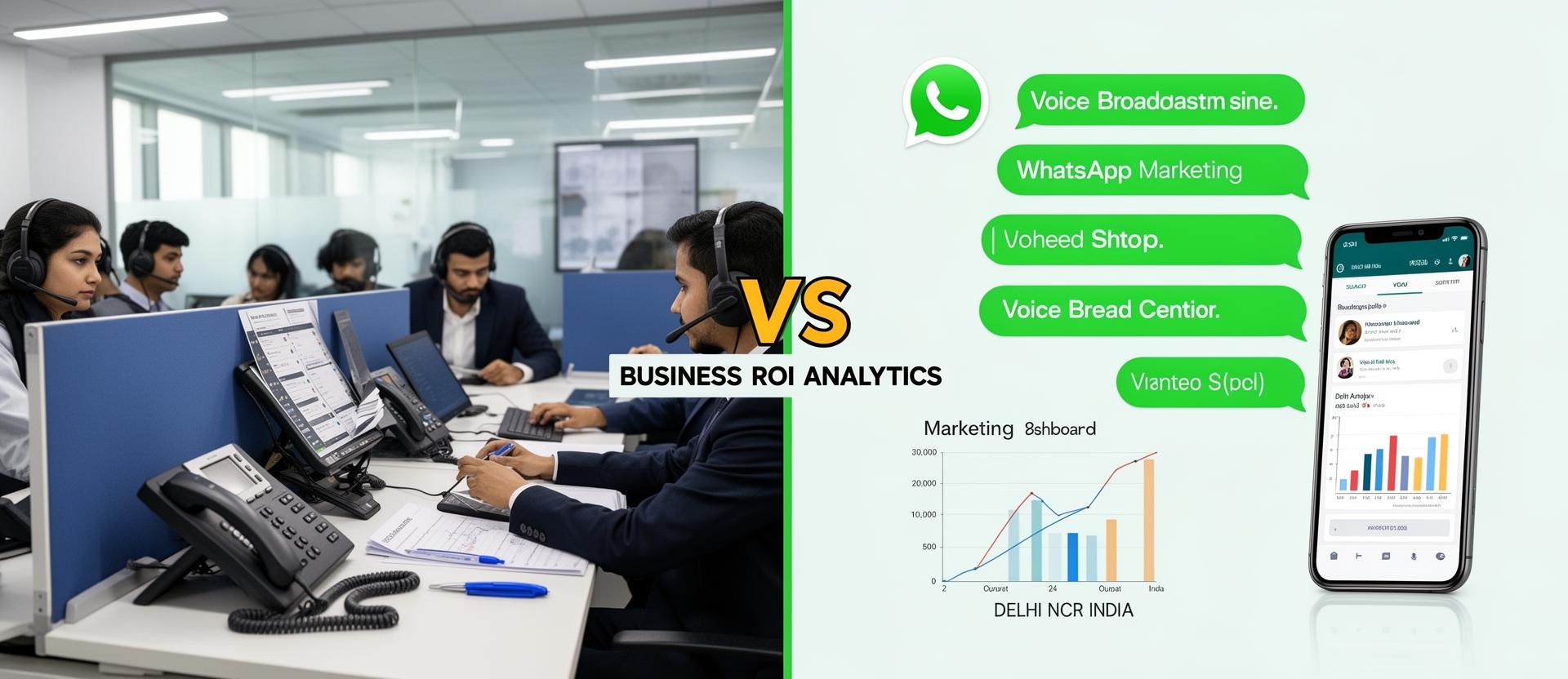
Based on our experience running campaigns for 100+ Delhi-NCR businesses across both channels, here's the typical ROI comparison for a campaign targeting 50,000 contacts:
Voice Broadcasting: Campaign cost ₹15,000–₹25,000. Connected calls ~25,000 (50%). Full listens ~17,000 (35%). IVR responses ~1,500 (3%). Conversions ~75–150. Cost per conversion: ₹100–₹330. Best for: awareness, reminders, collections, non-digital audiences.
WhatsApp Marketing: Campaign cost ₹35,000–₹45,000. Messages delivered ~47,500 (95%). Messages read ~40,000 (80%). Button clicks/responses ~7,500 (15%). Conversions ~375–750. Cost per conversion: ₹47–₹120. Best for: sales, lead generation, engagement, digital-first audiences.
WhatsApp delivers 3–5x more conversions at 40–60% lower cost-per-conversion for most Delhi-NCR business categories. The higher upfront cost per message is more than offset by dramatically higher engagement and conversion rates.
However, the optimal approach for most businesses isn't either/or — it's both, strategically deployed. Use WhatsApp as your primary engagement and conversion channel. Use voice broadcasting for reach extension (non-WhatsApp users), urgency-driven communications, and specific demographic segments.
The Hybrid Strategy: Best of Both Worlds
The smartest Delhi-NCR businesses use both channels in a coordinated workflow:
Layer 1 — WhatsApp First: Send your promotional campaign via WhatsApp API to all opted-in contacts. Track opens and engagement. This captures your highest-intent audience at the best cost-per-action.
Layer 2 — Voice Follow-Up: For contacts who didn't open the WhatsApp message within 24 hours, trigger a voice broadcast with a condensed version of the same offer. This captures the non-digital and non-responsive segment.
Layer 3 — Retargeting: For contacts who engaged with either channel but didn't convert (clicked but didn't buy, pressed 1 but didn't answer the callback), run a targeted WhatsApp follow-up with a stronger offer or urgency element.
This layered approach typically delivers 20–30% higher total conversions than using either channel alone, while keeping cost-per-acquisition optimized. The key is integrating both channels into a unified campaign management system with shared contact databases and cross-channel analytics.
Making Your Decision: A Quick Framework
Choose WhatsApp as your primary channel if: your audience is smartphone-heavy (urban Delhi-NCR, professionals, 18–55 age group), your product/service requires visual content or consultation, you need trackable ROI and CRM integration, you want two-way conversations that build relationships, and you're running ongoing campaigns (not one-off blasts).
Choose Voice Broadcasting as your primary channel if: your audience includes significant non-smartphone users, you need maximum reach at minimum cost, your message is simple and time-sensitive, you're in collections/payments/emergency notifications, or you're running large-scale awareness campaigns where depth of engagement is less important.
Choose a Hybrid Strategy if: you serve diverse demographics across Delhi-NCR, you run multi-touchpoint campaigns, you want to maximize reach AND conversion, and you have the infrastructure to coordinate cross-channel campaigns.
Whatever you choose, the worst decision is inaction. Every day your Delhi-NCR business isn't reaching customers on their preferred channel — whether voice or WhatsApp — is a day your competitors are capturing that attention instead.
Professional Voice Broadcasting & IVR Services
Reach thousands with compliant OBD campaigns, IVR calling, and automated voice broadcasting — DND-scrubbed, TRAI-compliant, and optimized for Delhi-NCR audiences.
Explore Voice Broadcasting →WhatsApp & RCS Marketing with API Panel
End-to-end WhatsApp Business API setup, chatbot development, broadcast campaigns, and RCS marketing — designed for maximum ROI in Delhi-NCR.
Explore WhatsApp Marketing →