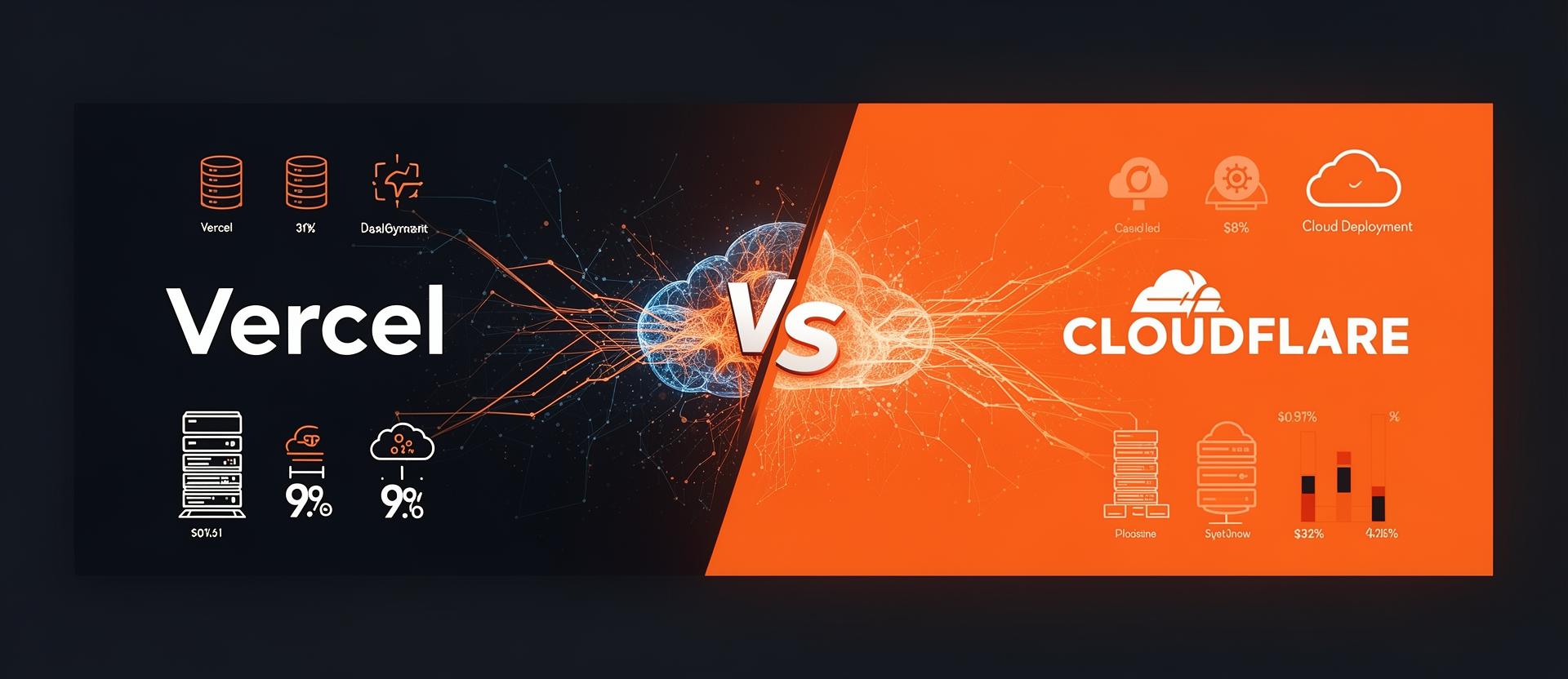
Vercel vs Cloudflare in 2026: Next.js vs Vinext, AI Game-Changers, Cost Breakdown & Best Practices for New Projects
The New Hosting War: Vercel and Cloudflare in 2026
The web hosting landscape has shifted dramatically. What used to be a simple choice between shared hosting and VPS has become a battle between two fundamentally different philosophies — Vercel, the company that created Next.js and runs on AWS infrastructure, and Cloudflare, which owns its entire global network of 300+ data centers. Both platforms now offer full-stack deployment, edge computing, AI inference, and database services — but their architectures, pricing models, and developer experiences diverge in ways that matter enormously for production workloads.
This comparison goes deep into the technical differences between Vercel's Next.js-first approach and Cloudflare's Vinext (Vite + edge-native) ecosystem, how AI workloads have reshaped the competitive dynamics, real cost analysis at various scales, and a practical decision framework for choosing the right platform for your next project.
Architecture: AWS-Powered vs Own-Network Edge
Vercel runs on AWS. Every serverless function, every ISR revalidation, every image optimization — it all runs on AWS Lambda, S3, and CloudFront under the hood. Vercel's value is the abstraction layer: you push code, and Vercel handles the deployment pipeline, CDN configuration, serverless function routing, and edge middleware. But you're paying for AWS infrastructure with Vercel's margin on top.
Cloudflare owns its infrastructure. Their network spans 300+ cities globally, and Workers run on every single node — not in a handful of AWS regions. This means true edge computing: your code runs within 50ms of virtually any user on earth. There's no cold start problem because Workers use V8 isolates (not containers), spinning up in under 5ms compared to Lambda's 200-1000ms cold starts.
This architectural difference has profound implications for latency, cost, and scalability. Vercel's Lambda-based functions have regional affinity — your API routes run in one region unless you explicitly configure edge runtime. Cloudflare Workers run everywhere by default. For global applications serving users across India, the US, Europe, and Southeast Asia, Cloudflare's architecture delivers consistently lower latency without any configuration.
Next.js vs Vinext: The Framework Battle
Vercel created Next.js and maintains it as the flagship framework for their platform. Next.js 15 introduced Partial Prerendering, React Server Components maturity, and Turbopack as the default bundler. It's a powerful, feature-rich framework — but it's also increasingly complex. The App Router, Server Actions, parallel routes, intercepting routes, and the server/client component boundary create a steep learning curve.
Cloudflare has invested heavily in Vinext — their Vite-based full-stack framework built specifically for edge-native deployment. Vinext uses Vite's fast build system, supports React (and other frameworks), and is designed from the ground up to run on Workers. It doesn't carry Next.js's legacy baggage, and its build times are significantly faster. A typical Vinext build completes in 2-4 seconds compared to Next.js's 15-45 seconds for equivalent projects.
The key difference: Next.js is a Node.js framework adapted for the edge, while Vinext is an edge-native framework from inception. This means Vinext doesn't hit the same limitations — no Node.js API compatibility issues, no surprising behavior differences between edge and Node.js runtimes, and no vendor lock-in to Vercel's deployment pipeline. However, Next.js has a massive ecosystem advantage: thousands of packages, tutorials, and community solutions that Vinext is still building.
How AI Has Changed the Game for Cloudflare
AI inference has been Cloudflare's killer move. Workers AI lets you run models directly on Cloudflare's network — Llama 3.3, Mistral, Stable Diffusion, Whisper, text embeddings, and more — with no GPU provisioning, no cold starts, and pricing per token/request rather than per-hour GPU rental. For AI-powered features (chatbots, content generation, image analysis, semantic search), this eliminates the complexity of managing separate AI infrastructure.
Cloudflare Vectorize provides a native vector database on the same network, so your RAG (Retrieval Augmented Generation) pipeline — embeddings, vector search, and LLM completion — all runs within Cloudflare's edge without any external API calls. The latency advantage is dramatic: a RAG query that takes 800ms with Vercel (API route → OpenAI → Pinecone → OpenAI) can complete in 200ms on Cloudflare (Worker → Workers AI → Vectorize → Workers AI).
Vercel's AI SDK is excellent for integrating with external AI providers (OpenAI, Anthropic, Google), but you're still paying for those API calls plus Vercel's serverless function execution time. Cloudflare's approach of running inference on their own hardware means AI features can be 3-5x cheaper at scale. For startups and SMBs building AI-first products, this cost difference can determine viability.
The future trajectory is clear: Cloudflare is positioning itself as the full-stack AI deployment platform where your application logic, AI inference, vector storage, and traditional database all run on the same global network. Vercel is positioning as the best frontend deployment platform with excellent integrations to external services. Both are valid strategies, but Cloudflare's vertically integrated approach has a structural cost advantage for AI-heavy workloads.
Cost Comparison: Real Numbers at Scale
Free tier: Vercel offers 100GB bandwidth, 100 hours serverless function execution, and 1000 image optimizations. Cloudflare's free tier includes unlimited bandwidth (yes, unlimited), 100,000 Worker requests/day, and 10ms CPU time per invocation. For hobby projects and small sites, Cloudflare's free tier is dramatically more generous.
Pro tier ($20/month): Vercel Pro gives you 1TB bandwidth, 1000 hours function execution, and team features. Cloudflare Workers Paid ($5/month) gives you 10 million requests, 30ms CPU time, and Workers KV storage. For the same $20, you get far more capacity on Cloudflare. A typical SaaS application serving 50,000 monthly users costs roughly $20-50/month on Vercel Pro versus $5-15/month on Cloudflare Workers Paid.
At scale (100K+ users): This is where the AWS tax becomes painful. Vercel's enterprise plans start around $3,000-6,000/month. Equivalent workloads on Cloudflare Enterprise run $1,500-3,000/month — roughly 50% less — because Cloudflare doesn't have AWS's margin baked into every request. Bandwidth alone can be a 10x difference: Vercel charges for bandwidth beyond tier limits while Cloudflare includes unlimited bandwidth on all plans.
AI workload costs: Running 1 million AI inference requests per month — Vercel + OpenAI API: ~$800-2,000 (function execution + API costs). Cloudflare Workers AI: ~$150-400 (built-in inference, no external API). The savings compound because you're eliminating both the external API cost and the serverless execution time for managing those API calls.
Database costs: Vercel Postgres (powered by Neon) costs $0.10/compute-hour after the free tier. Cloudflare D1 (SQLite at the edge) offers 5GB free, then $0.75/GB/month — significantly cheaper for read-heavy workloads typical of web applications.
Developer Experience: Where Vercel Still Wins
Vercel's developer experience remains best-in-class. The GitHub integration is flawless — push to a branch, get a preview deployment in seconds, merge to main, and it's live. The dashboard, analytics, and logs are polished and intuitive. Vercel's v0 AI tool generates production-quality Next.js components from prompts. And the Next.js ecosystem means almost every React library works out of the box.
Cloudflare's developer experience has improved enormously but still has rough edges. Wrangler (their CLI) is powerful but sometimes inconsistent. The Cloudflare dashboard is functional but not as polished as Vercel's. Debugging Workers can be trickier because you're running in V8 isolates, not Node.js — so some Node.js APIs aren't available, and stack traces can be less informative.
For teams with strong JavaScript/TypeScript skills, Cloudflare's learning curve is manageable. For teams that want the fastest path from idea to production without deep infrastructure knowledge, Vercel remains the smoother choice. The trade-off is cost and architectural flexibility: Vercel makes it easy but expensive at scale; Cloudflare makes it cheaper but requires more infrastructure awareness.
The Future: Where Both Platforms Are Headed
Cloudflare's trajectory is vertical integration. They're building a complete cloud platform — compute (Workers), storage (R2, D1, KV, Durable Objects), AI (Workers AI, Vectorize), security (WAF, DDoS, Bot Management), and media (Stream, Images). The end game is becoming an AWS alternative that's simpler, cheaper, and edge-native. Their recent acquisitions in observability and their Constellation AI platform signal they're serious about owning the full stack.
Vercel's trajectory is framework excellence and AI-powered development. They're doubling down on Next.js as the definitive React meta-framework, building v0 into an AI development companion, and expanding their platform with storage, analytics, and observability features. Vercel's bet is that developer experience and framework quality matter more than infrastructure cost at the scales most teams operate.
The likely outcome: Cloudflare wins on cost, performance, and AI-heavy workloads. Vercel wins on developer experience, ecosystem maturity, and enterprise adoption. Neither will kill the other — they'll serve different segments of the market. But Cloudflare's cost advantage will increasingly pull cost-conscious startups and scale-ups away from Vercel, especially as Vinext and the Workers ecosystem mature.
Best Practices: Starting a New Project in 2026
Choose Vercel + Next.js if: You need the fastest time-to-market with React, your team already knows Next.js, you're building a content-heavy marketing site or e-commerce platform, you rely heavily on the Next.js ecosystem (next-auth, next-intl, etc.), or your budget accommodates Vercel's pricing at your expected scale.
Choose Cloudflare + Vinext/Workers if: You're building an AI-first product, you need true global edge performance, cost efficiency is critical (bootstrapped startup, high-volume SaaS), you want to avoid AWS vendor lock-in, or you're building real-time features (WebSockets via Durable Objects, event-driven architectures).
Hybrid approach (recommended for most teams): Use Cloudflare for your CDN, DNS, DDoS protection, and WAF regardless of where you deploy. If you choose Vercel, put Cloudflare in front as a reverse proxy — you get Cloudflare's security and caching with Vercel's deployment pipeline. Many production setups use Cloudflare R2 for file storage, Cloudflare Workers for API endpoints, and Vercel for the Next.js frontend.
For Indian businesses specifically: Cloudflare's Mumbai and Chennai PoPs provide excellent latency for domestic users. If your primary audience is in India, Cloudflare's edge-first architecture will outperform Vercel's regional Lambda deployments. Combine this with cost savings, and Cloudflare is often the better choice for Indian startups and SMBs building SaaS products or AI-powered services.
Migration Checklist: Moving Between Platforms
Moving from Vercel to Cloudflare: Audit your Next.js codebase for Node.js-specific APIs that won't work in Workers (fs, child_process, etc.). Replace next/image with Cloudflare Images. Migrate your database from Vercel Postgres to D1 or Turso. Convert API routes to Workers or use Vinext's server routes. Update your CI/CD to use Wrangler for deployments. Plan for 2-4 weeks of migration effort for a medium-complexity app.
Moving from Cloudflare to Vercel: Port your Workers to Next.js API routes or middleware. Replace D1 queries with Prisma/Drizzle for Vercel Postgres. Migrate R2 assets to Vercel Blob Storage. Update DNS to point to Vercel's CDN. This direction is generally easier because Next.js is more permissive than Workers runtime.
For new projects: Start with a clear deployment target and build for that platform from day one. Avoid abstracting your deployment layer prematurely — it adds complexity without value unless you genuinely plan to support both platforms. Pick one, commit, and optimize for it.
Final Verdict: It Depends on Your Priorities
There's no universal winner. Vercel is the better choice for teams that value developer experience, ecosystem maturity, and rapid prototyping. Cloudflare is the better choice for teams that value cost efficiency, edge performance, and AI-native infrastructure. The gap in developer experience is closing fast as Cloudflare invests in tooling, while the cost gap is widening as AI workloads grow.
Our recommendation for most new projects in 2026: Start with Cloudflare Workers + Vinext if you're building a SaaS or AI product, and Vercel + Next.js if you're building a marketing site, e-commerce store, or content platform. Use Cloudflare's CDN and security layer regardless of your hosting choice. And always benchmark your specific workload on both platforms before committing — free tiers on both are generous enough for meaningful testing.
Need a High-Performance Website Built Right?
We build fast, edge-optimized websites using the right framework and hosting platform for your business — React, Next.js, Vite, or custom solutions deployed on Vercel, Cloudflare, or hybrid setups.
Explore Web Development Services →Build AI-Powered Features with Cost-Optimized Routing
Learn how ClawRouter cuts AI inference costs by 92% with intelligent model routing — perfect for deploying AI features on Cloudflare Workers or any edge platform.
Read the ClawRouter Deep Dive →Related Articles

Why Website Speed Matters More Than Ever in 2026
6 min read
How to Choose the Right Web Development Framework for Your Business in 2026: React, Next.js, WordPress or Custom?
15 min read
Hybrid WordPress Deployment: How wpup.in Powers Static Websites With WordPress Backend on a Separate Domain
14 min read